










Structure Behavioral Intel with the AI Psychographic Data API

Supply your internal risk and verification pipelines with high-fidelity behavioral data points derived from global open networks. ESPY’s asynchronous data tier streams unstructured web footprints into schema-valid JSON arrays, allowing enterprise platforms to enrich institutional risk, fraud, and identity verification models at sub-100ms query latency.

Async POST/GET

PRODUCTION PIPELINE

OSINT-Driven

COMPLIANCE-BY-DESIGN

JSON Arrays

STRUCTURED ENRICHMENT

AI Psychographic Data API

The Behavioral Identity Model

Standard vendor tools operate as stagnant demographic trackers. ESPY functions strictly as an advanced data tier, exposing the AI Psychographic Data API to structure public unstructured digital footprints into machine-readable datasets. The pipeline maps target identity attributes, profile longevity, and cross-platform activity signals directly into unified JSON objects without relying on stale database caches.

Attribute Classification Arrays

Converts raw, unstructured public footprints into standardized behavioral tags. The data feed extracts cross-platform markers to categorize identities based on verified digital self-expression, isolating active professional and behavioral footprint attributes.

Primary Motivation Vectors

Outlines operational consistency drivers behind identity actions. Instead of generalized profiles, the feed supplies structured markers to evaluate identity longevity, digital footprint depth, and sudden activity velocity shifts.

Profile Consistency Telemetry

Evaluates the structural stability and historical depth of a digital persona over time. By analyzing public-domain web archives, this dataset serves as an analytical layer for institutional risk assessment and synthetic identity verification.

High-Fidelity Psychographic Feeds for System Integrators

ESPY operates strictly as a non-retaining data tier for enterprise software developers, fintechs, and defense platforms. We supply raw, machine-readable psychographic datasets that seamlessly integrate into the complex screening, risk, and analytics platforms you build for institutional clients.

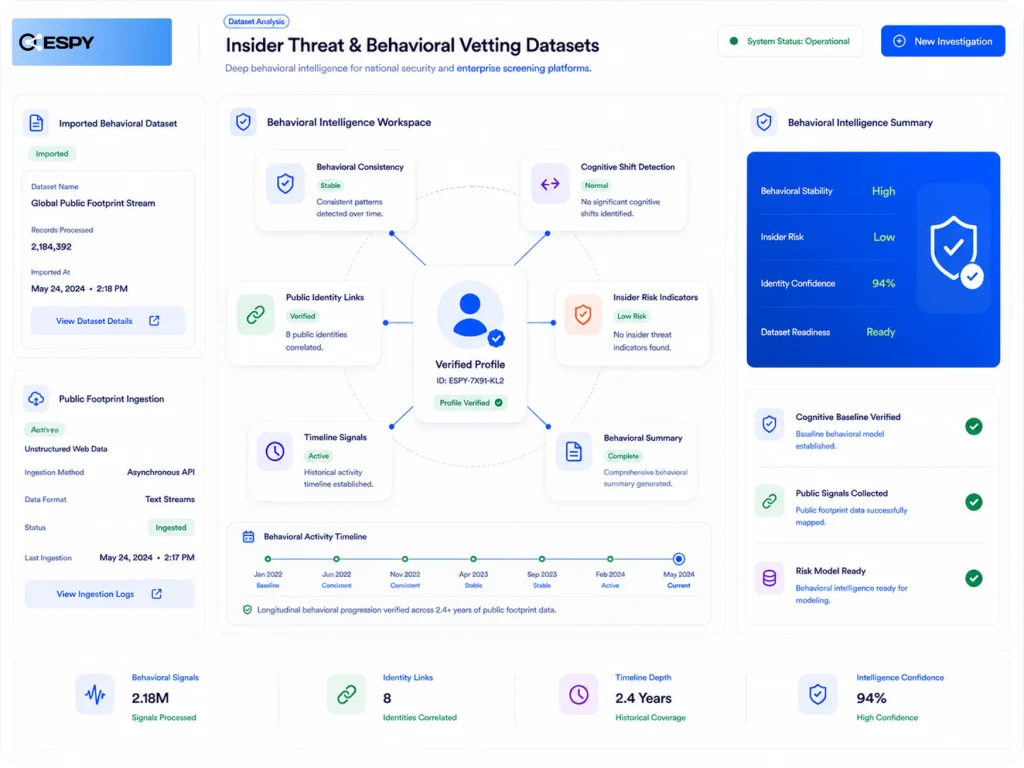
Insider Threat & Behavioral Vetting Datasets

Enrich your national security and background screening architectures with deep behavioral intelligence. ESPY supplies unstructured public footprint data streams, allowing your engineering teams to build automated vetting platforms that isolate anomalous activity shifts and risk indicators without retaining PII.

  • Anomalous Shift Feeds: Delivers clean data arrays to fuel your platform’s internal anomaly detection models.

  • Cross-Network Graph Extraction: Supplies public identity connection matrices to verify persona authenticity.

  • Sovereignty-Compliant Delivery: Runs asynchronous open-source text processing built for highly regulated tech stacks.

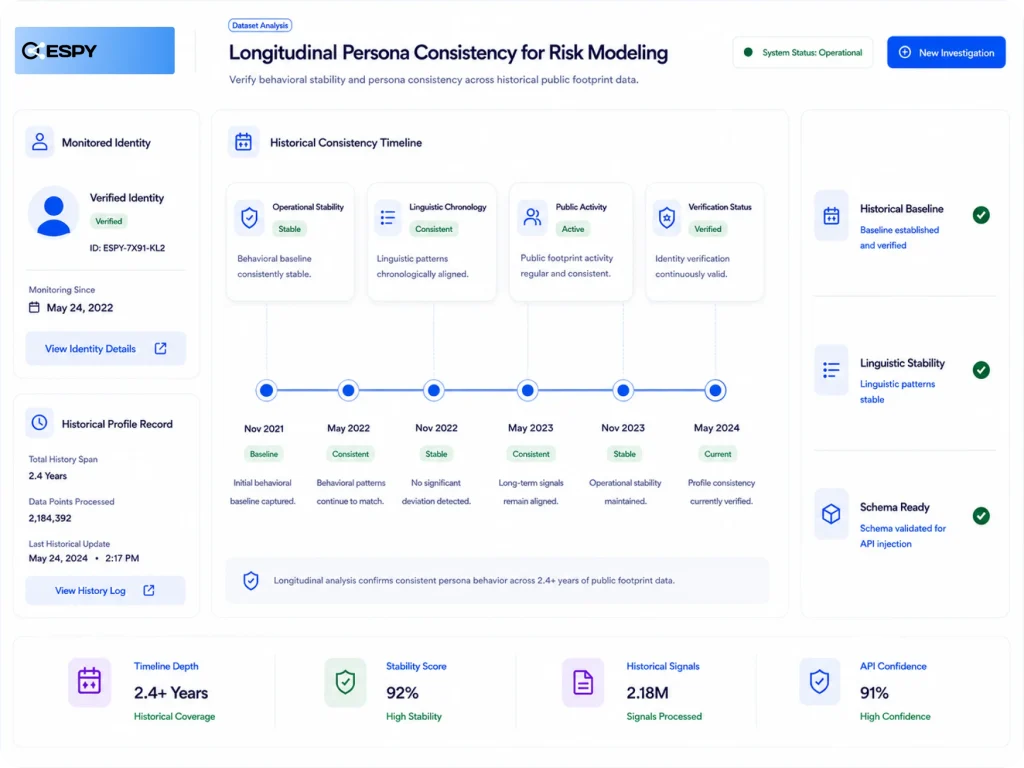
Longitudinal Persona Consistency for Risk Modeling

Verify the baseline stability of a digital profile over time. ESPY delivers structured behavioral consistency signals that integrate directly into your custom analytics pipelines, providing supplementary identity-layer verification without custom database overhead.

  • Operational Stability Logs: Provides long-term behavioral consistency metrics from public footprints to feed your algorithms.

  • Linguistic Chronology Telemetry: Isolates programmatic text markers required by institutional risk logic.

  • Schema-Valid Output: Injects structured trait arrays directly into your platform’s active API endpoints.

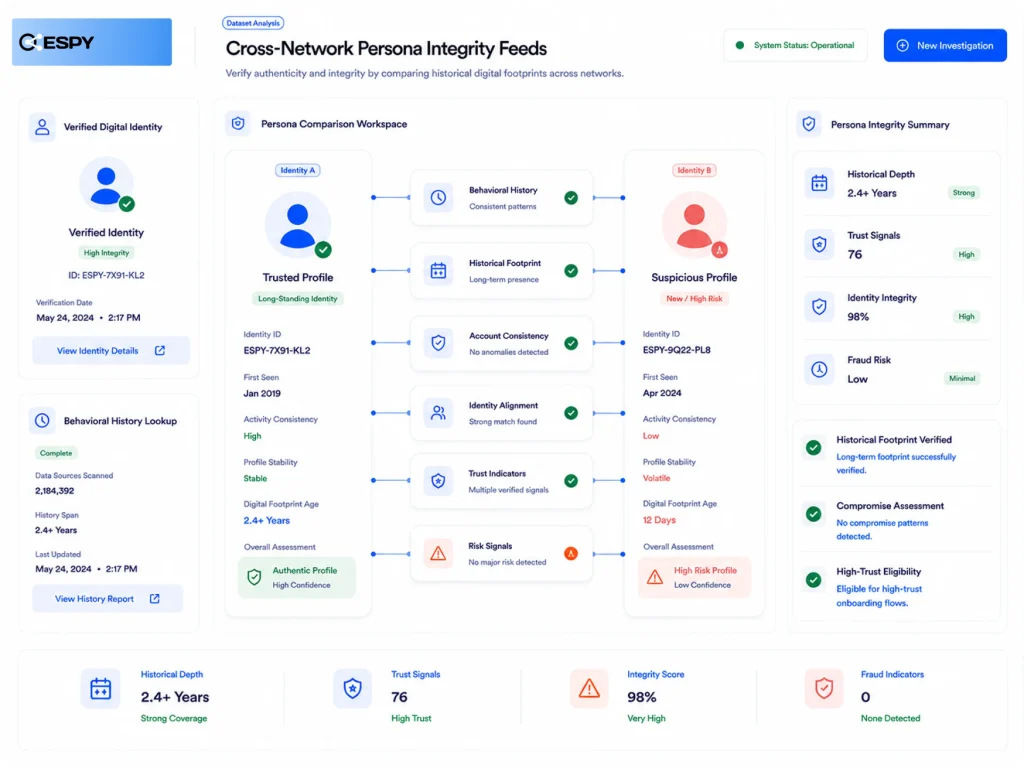
Cross-Network Persona Integrity Feeds

Synthetic identity fraud bypasses standard KYC components within enterprise networks. We provide your fraud prevention infrastructure with deep historical digital footprint data, enabling your software to separate authentic digital histories from newly fabricated profiles.

  • Footprint Chronology Metrics: Quantifies the age, alignment, and historical depth of public digital footprints.

  • Account Compromise Triggers: Flags sudden, automated velocity shifts in public text profiles.

  • Whitelisting Integration Arrays: Supplies high-trust profile matrices to accelerate institutional onboarding flows.

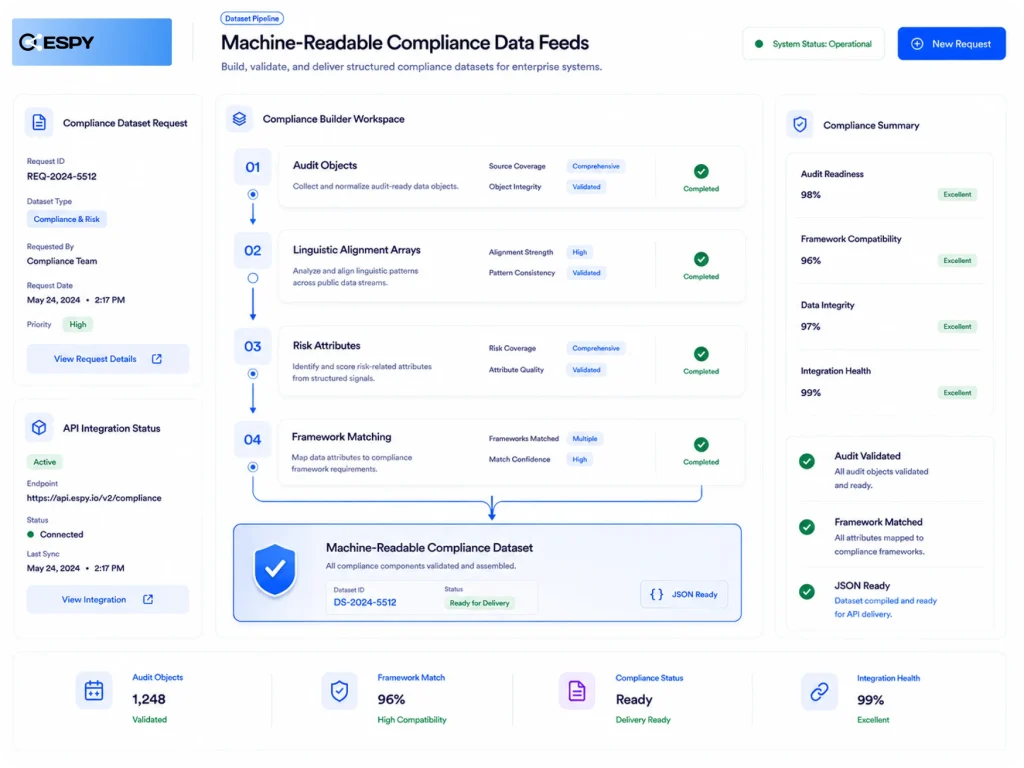
Machine-Readable Compliance Data Feeds

Large-scale governance platforms require objective, external data layers to maintain automated auditing. ESPY feeds pre-structured psychographic and risk-propensity metrics straight into your monitoring software, ensuring your compliance solutions run on raw intelligence.

  • Audit-Ready Data Objects: Outputs standardized JSON structures fit for formal compliance checks.

  • Linguistic Alignment Arrays: Analyzes structural and thematic consistency across public communication channels to detect anomalies or sudden profile ownership shifts.

  • Framework-Agnostic Matching: Maps text stream traits to fit into any internal corporate risk logic you build.

Programmatic Psychographic Ingestion Standards

ESPY provides the secure infrastructure necessary to stream raw behavioral and psychographic datasets into proprietary platforms. Our machine-readable feeds allow system integrators to enrich institutional risk, vetting, and screening engines without operational overhead.

Zero-Retention Compliance: ESPY aggregates publicly available web infrastructure records and open-source feeds without storing unauthorized PII. The data pipeline operates via live processing loops, ensuring the underlying datasets align with strict international privacy frameworks (GDPR / CCPA).

Psychographic Response Schema & Parameters

Consistent, schema-valid JSON delivered on every data feed request. System integration requires zero platform-side filtering, providing structured behavioral vectors designed for seamless ingestion into institutional pipelines.

AI Psychographic Data API

Psychographic Data Output Specifications

ESPY normalizes unstructured open-source text streams into structured, machine-readable behavioral vectors. Our API delivers predictable schema-valid outputs designed to integrate natively with institutional risk architectures, compliance layers, and internal scoring systems.

Psychographic Vectoring

Extracts core baseline behavioral matrices from open-source communication records. This data allows third-party scoring engines to evaluate underlying identity profiles without processing raw text.

Behavioral Depth Ingestion

Normalizes historical self-expression layers from distributed public web footprints. Integrators receive clean timeline logs to evaluate cross-network data volume and profile consistency over extended durations.

Anomaly & Shift Detection

Isolates sudden, programmatic deviations from an established behavioral baseline. The data feed returns structured telemetry flags when public communication patterns indicate high institutional risk.

Cross-Network Identity Alignment

Quantifies linguistic and thematic synchronization across unlinked digital footprints. Delivers an objective confidence score to help platforms verify identity authenticity and filter fabricated profiles.

Multi-Language Logic Mapping

Translates and normalizes cross-border public web interaction data into uniform psychographic tags, ensuring consistent risk evaluation logic across different regions and languages.

Platform-Agnostic Schema

Streams pre-formatted, schema-valid JSON objects built for instant ingestion. The data outputs connect directly into existing institutional SIEM, SOAR, or custom corporate risk pipelines.

The Global Network Pulse Layer: Scalable Psychographic Data Ingestion

Scale across global networks without engineering bottlenecking. ESPY provides a scalable ingestion tier that structures raw open-source intelligence and delivers machine-readable datasets directly to your platform endpoints.

400+

Indexed Data Nodes

1-Click

Reverse Data Resolution

100+

Languages Native Support

The baseline pulse engine evaluates behavioral data consistency across international networks, leveraging distributed crawler nodes to access public discussion forums, open registries, and web-scale text archives. It computes dynamic psychographic vectors and anomalous shift telemetry to flag immediate risk factors, compliance anomalies, and community identity manipulation. Engineered for enterprise high-velocity systems, the API outputs schema-valid JSON to automate profile enrichment at massive scale.

Map, Structure, and Ingest Psychographic Data Fields

ESPY handles the engineering overhead of aggregating unstructured public spaces, converting raw open-source footprints into clean, machine-readable data structures designed for seamless integration and custom routing.

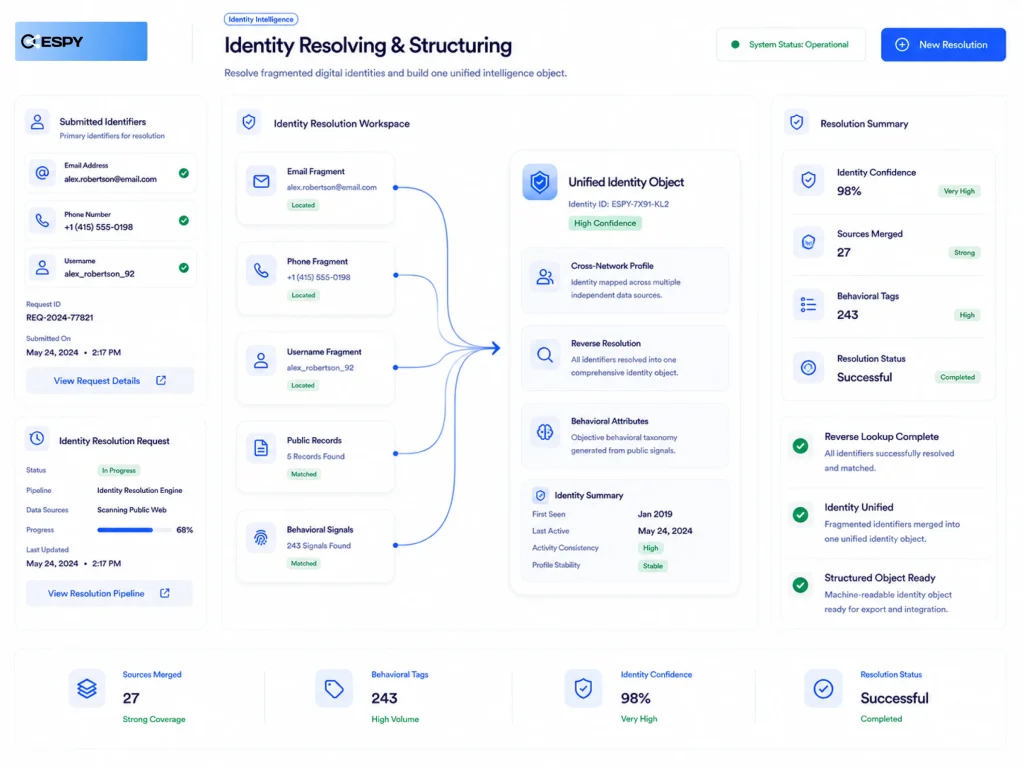
Identity Resolving & Structuring

  1. Cross-Network Profiling: Maps fragmented public web signatures across multiple independent platforms into a single data object.
  2. Reverse Resolution Feeds: Converts standalone identifiers like emails or phone numbers into broad psychographic matrices natively.
  3. Dynamic Attribute Tagging: Generates objective behavioral taxonomy markers directly from public interaction history.

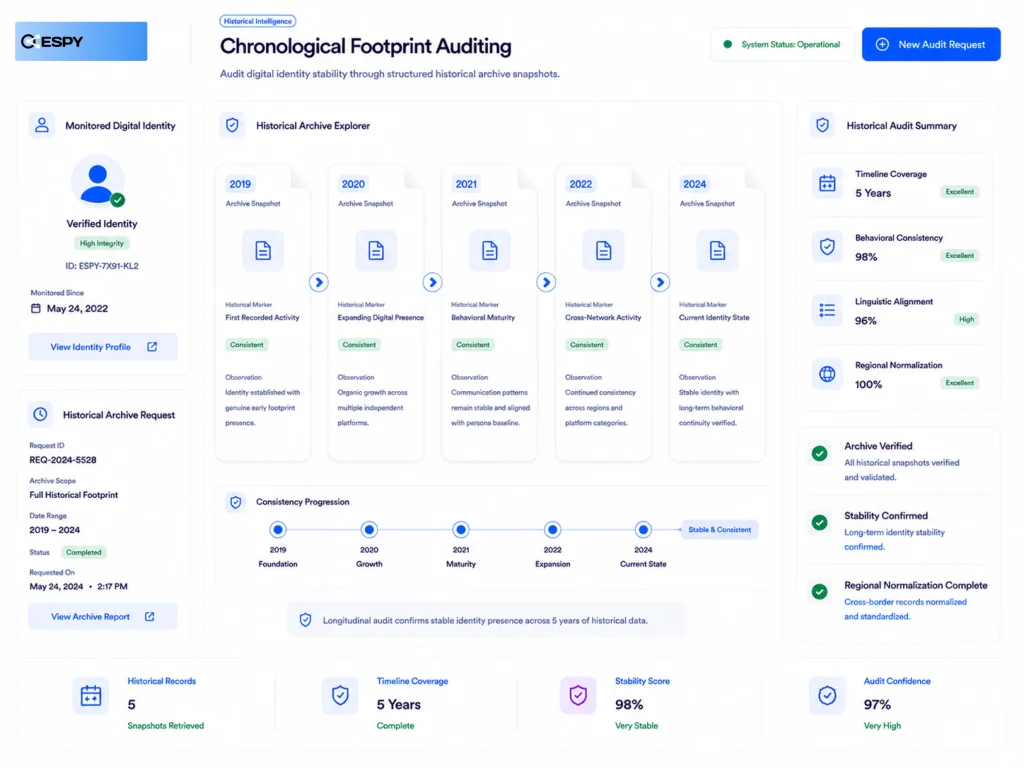
Chronological Footprint Auditing

  1. Long-Term Data Baselines: Delivers years of structured historical text data to evaluate ongoing persona and profile stability.

  2. Linguistic Consistency Tracing: Tracks multi-year communication alignment to detect artificial profile setups or sudden identity shifts.

  3. Regional Source Normalization: Standardizes cross-border open-source records into unified, region-agnostic profiles.

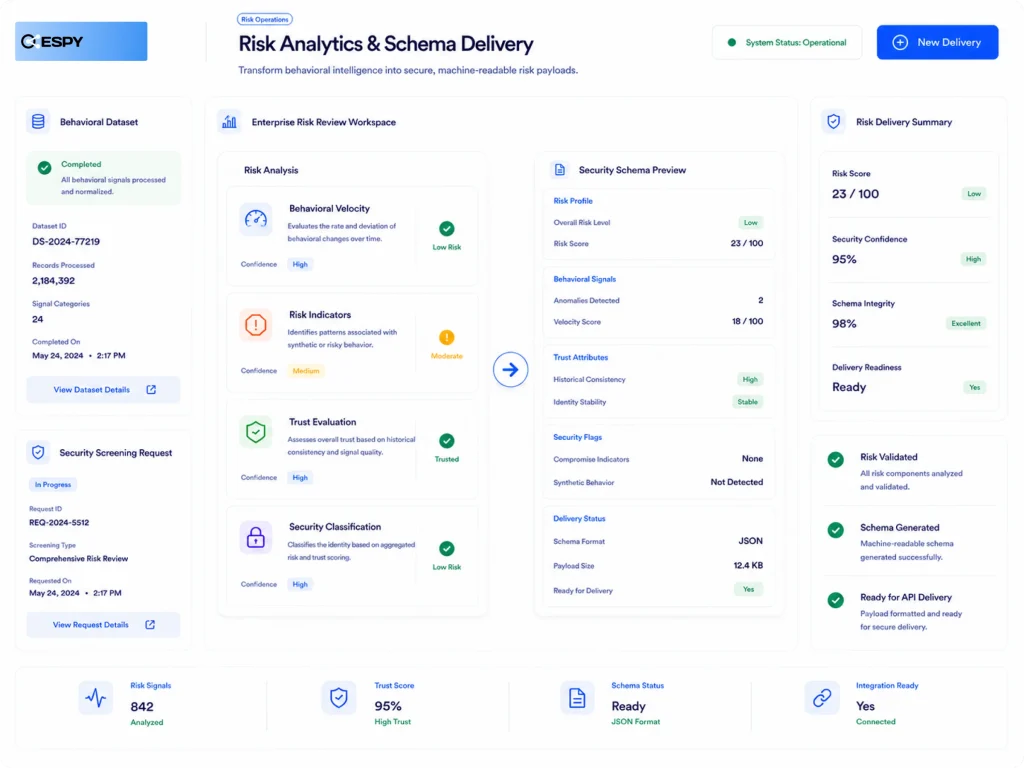
Risk Analytics & Schema Delivery

  1. Anomalous Velocity Metrics: Flags rapid shifts in public self-expression parameters to feed third-party risk logic engines.

  2. Immutable Output Vectors: Formats complex psychographic datasets into lightweight payloads ready for automated security screening.

  3. Native Pipeline Compatibility: Delivers clean JSON code arrays built for immediate ingestion into institutional SIEM, SOAR, or risk networks.

Why Technical Leaders Choose ESPY Psychographic Feeds

Traditional vendors rely on static, cached databases that miss the evolving digital footprint behind target identities. ESPY delivers real-time, multi-network psychographic vectors designed for high-performance enterprise systems.

Traditional Lookup Tools

ESPY Psychographic Data API

Architecting the Psychographic Data Tier

Supplying enterprise platforms with structured, compliant identity data feeds.

ESPY functions as a specialized infrastructure layer built to supply enterprise architectures with high-fidelity psychographic metrics. Our data tier aggregates distributed open-source footprints, mapping them into unified identity objects and chronological baselines to ensure complete database integrity. Engineered strictly for data platforms, risk analysts, and system integrators, the pipeline delivers clean, schema-valid JSON arrays that automate institutional identity validation and enrichment with zero compliance friction.

Trusted by developers, system architects, and trust and safety teams worldwide.

Ronald Richards

CEO & Founder

The Identity Data Resolution Pipeline

An automated three-stage engine that transforms raw public footprints into structured analytical vectors. Our pipeline handles the extraction, trait classification, and secure streaming of intelligence profiles in real time.

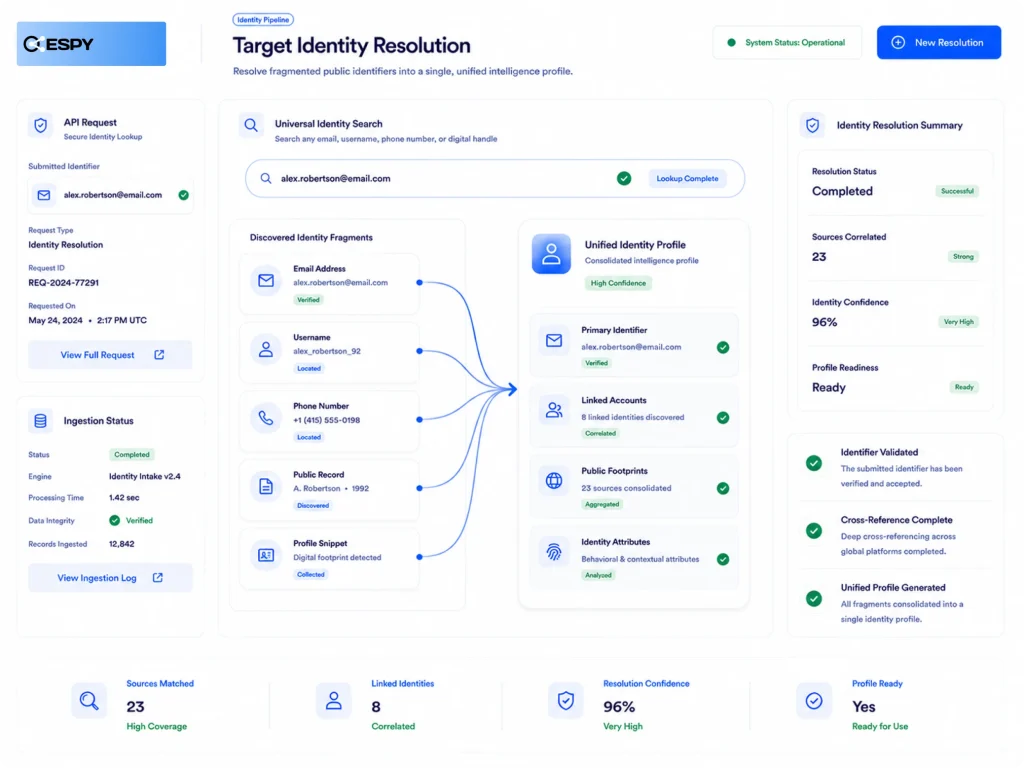
Target Identity Resolution

  1. Single-Point Ingestion: The API receives an isolated identifier, such as an email address or digital handle, via a secure request.
  2. Deep Reverse Cross-Referencing: The engine scans primary global platforms and social networks simultaneously to isolate linked accounts and digital aliases.

  3. Footprint Consolidation: Fragmented public signatures are grouped together into a single, unified target profile layout.

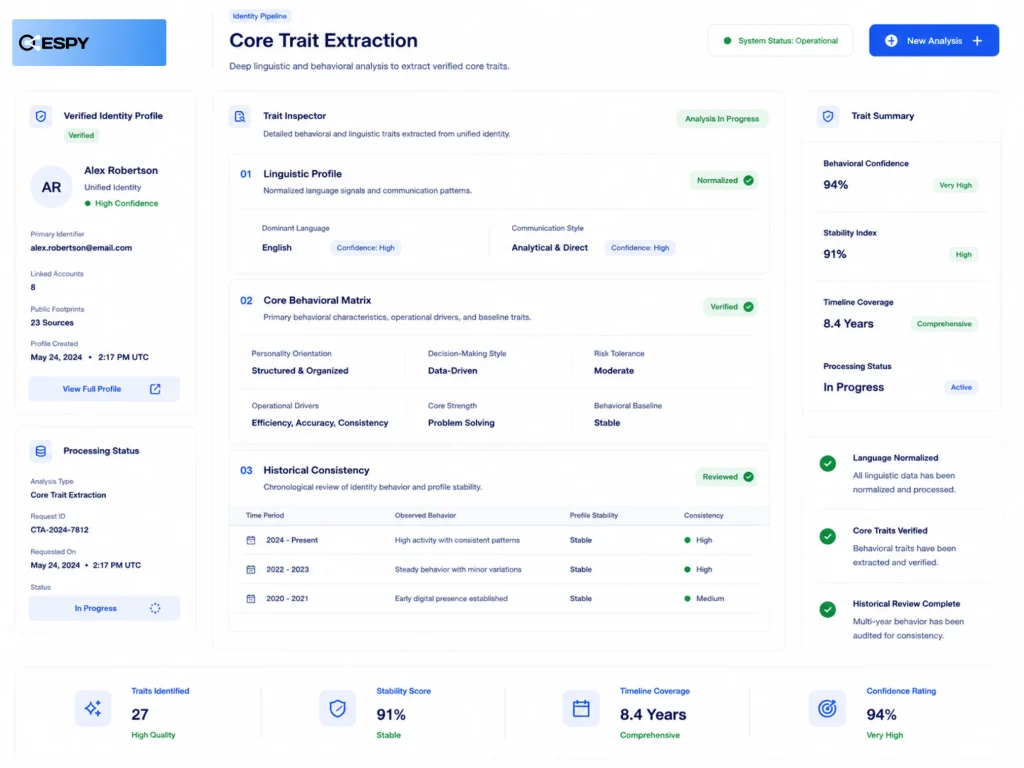
Core Trait Extraction

  1. Linguistic Profile Normalization: Raw public text streams are cleaned and processed to remove background network noise.
  2. Analytical Matrix Generation: The engine isolates structural stability indicators, core baseline characteristics, and primary operational drivers.
  3. Chronological Timeline Auditing: The system evaluates the depth and consistency of the digital persona over multi-year periods.

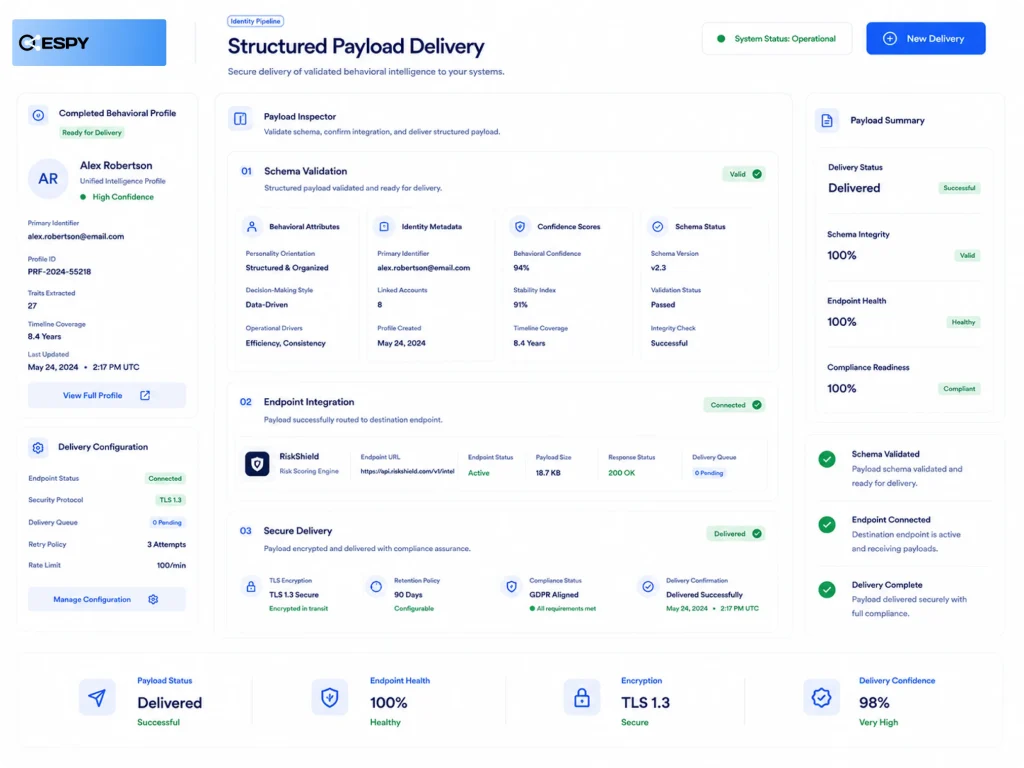
Structured Payload Delivery

  1. Schema-Valid Formatting: Complex behavioral attributes are compressed into an organized, machine-readable JSON structure.

  2. Native Endpoint Ingestion: The data feed streams the unified profile payload directly into third-party scoring engines and risk systems.

  3. Encrypted Delivery: Payloads stream over TLS with configurable retention windows, structured to support GDPR-aligned data-handling workflows.

Benchmarking Core API Capabilities

Discover the architectural difference between automated intelligence streaming and legacy lookups. This comparison details how our enterprise infrastructure expands data depth, eliminates technical debt, and ensures schema-valid routing.

Feature Traditional Reverse Search Standard OSINT Tools Manual Web Monitoring
Real-time carrier mapping
Via Metadata
Cross-platform profile matching
Via Transforms
Identity & alias discovery
VoIP & virtual line detection
Built In
Core Feature
Live reputation scoring
Partial
Limited
Connected footprint mapping
US only

US only

Automated data pipelines

Paid

Global registry scanning
Add-on
No technical skills needed
Requires Training
Free trial access
No Card Needed
Limited
Limited
Limited

Trusted by System & Architecture Teams

See how engineering leads, data architects, and security officers deploy ESPY’s structured feeds to eliminate internal scraping pipelines and enrich their platforms.

We linked our proprietary analysis engines to this API to bypass standard database search limits. Our queries scale continuously without any platform lag, giving us complete target clarity before internal triggers deploy.

Simon K.

Head of Core Infrastructure

We used to maintain expensive, unstable internal scrapers to track profile anomalies across public spaces. Migrating to this unified API allowed us to decommission that broken infrastructure and rely entirely on one clean feed.

Oliver M.

VP of Technical Operations

Most intelligence feeds require massive local filtering scripts to be useful. This solution pushes pre-formatted JSON objects directly into our Snowflake data warehouse, completely removing manual parsing friction for our engineers.

Julian V.

Lead Database Engineer

The deep trait mapping delivers extreme precision. We don’t just get a basic account verification; the payload structures chronological communication history to surface long-term footprint consistency natively.

Yuki H.

Senior Backend Architect

Processing text data across international networks usually meant building separate translation layers. Standardizing clean metrics across multiple global regions directly at the ingestion tier saved our team massive cloud compute costs.

Rohan J.

Systems Integration Lead

During urgent entity vetting, delayed data resolution makes a system obsolete. The sub-minute endpoint response ensures our network security teams fetch comprehensive public data records the moment an anomaly is detected.

Tarek A.

Chief Information Security Officer

Isolating long-term behavioral consistency within our screening tools used to require massive internal data modeling. ESPY’s structured trait vectors allowed us to automate authentic digital history verification directly at the ingestion layer.

Christian L.

Director of Engineering

Frequently Asked Questions

Everything you need to know about behavioral data ingestion, psychographic trait schemas, privacy compliance, and technical API integration.

How does the API maintain privacy and regulatory compliance?

The ESPY API operates strictly within a zero-retention architecture, querying only publicly accessible web directories, open discussion networks, and indexed archives. The pipeline does not store Personally Identifiable Information (PII) post-delivery, ensuring workflows are structured to align with international privacy frameworks (such as GDPR and CCPA).

Query response times average low-latency execution for standard API endpoint requests, powered by ESPY’s global CDN distribution. Deep multi-network reverse resolution scans execute asynchronously to ensure zero latency overhead on your application’s client side.

Yes. The API outputs schema-valid JSON objects engineered for immediate ingestion into institutional workflows. The behavioral datasets easily map to standard security, auditing, and threat intelligence environments without requiring custom parsing layers or heavy internal development overhead.

Our infrastructure bypasses static database caches to run live, synchronized lookups across 400+ open networks at the moment of request. This guarantees that all delivered psychographic trait attributes, digital signatures, and cross-platform connection markers reflect the active, real-time status of the target identity.

Yes. Developers can use standard request parameters to adjust rate limits, isolate specific target open networks, and define exactly which behavioral profile trait matrices should be pulled. This ensures your system only processes high-fidelity payloads tailored to your platform’s logic.

The API monitors longitudinal profile consistency and linguistic telemetry over multi-year timelines. Sudden velocity shifts, abrupt changes in communication style, or newly created profiles lacking historical digital footprint depth trigger structured anomaly flags in the response payload.

Verify with Confidence. Stream Identity Data with ESPY

Access our structured data infrastructure to automate target profile resolution, eliminate manual scraping overhead, and route compliant intelligence arrays through a unified API framework.

Related Guides

The Missing Piece in Modern Background Checks

Imagine you are about to hire someone, rent out a property, choose a contractor, or enter

How to Do Reverse Phone Lookup: A Practical Guide to Checking an Unknown Number

An unfamiliar number can be a nuisance or the first clue in a fraud review, customer

How to Maximize OSINT With Cognyte Analytics: A Practical Investigation Workflow

Poorly prepared information can weaken an investigation before analysis begins. Investigators studying how to maximize OSINT