










Multilingual Sentiment Analysis Data API

Analyze text collected from social networks, online posts, news sources, or submitted directly through the API. ESPY classifies sentiment as positive, negative, or neutral, identifies main topics, and generates a concise summary of the content. Unlike conventional sentiment-analysis solutions that translate content into English before processing it, ESPY analyzes text directly in its original language. This helps preserve linguistic context, tone, and meaning for more accurate multilingual sentiment analysis.

100+

LANGUAGES SUPPORTED

Sub-100ms

Query Latency

Real-Time

VELOCITY TRACKING

Sentiment Analysis Data API

The Multi-Vector Sentiment Model

Standard vendor tools operate as frontend monitoring applications. ESPY functions strictly as a raw data tier, streaming unstructured public network logs and news subnets directly into your platform’s backend architecture. The pipeline converts high-throughput text streams into schema-valid JSON matrices, delivering raw sentiment analysis data arrays without relying on stale database caches.

Tri-State Polarity & Main Topic Extraction

Classifies unstructured text payloads directly into Positive, Negative, or Neutral sentiment categories while isolating core discussion topics. ESPY generates a concise content summary and analyzes text natively in its original language to preserve exact tone and meaning.

Aspect-Based Emotion Detection

Attributes sentiment analysis scores directly to specific targets-such as an enterprise entity, an executive statement, or a compliance event-instead of scoring entire documents as a single blob. The system parses text blocks to isolate and weight individual entity mentions.

Volume & Velocity Telemetry

Tracks how fast conversation grows against historical baselines and triggers automated flags on sudden negative spikes. This structural tracking functions as an early warning layer for compliance risks, merchant fraud threats, and immediate operational anomalies.

High-Throughput Sentiment Analysis Engines

ESPY supplies structured, low-latency data arrays engineered for automated decisioning systems. Integrate raw sentiment analysis metrics directly into your internal compliance pipelines, risk engines, or onboarding logic.

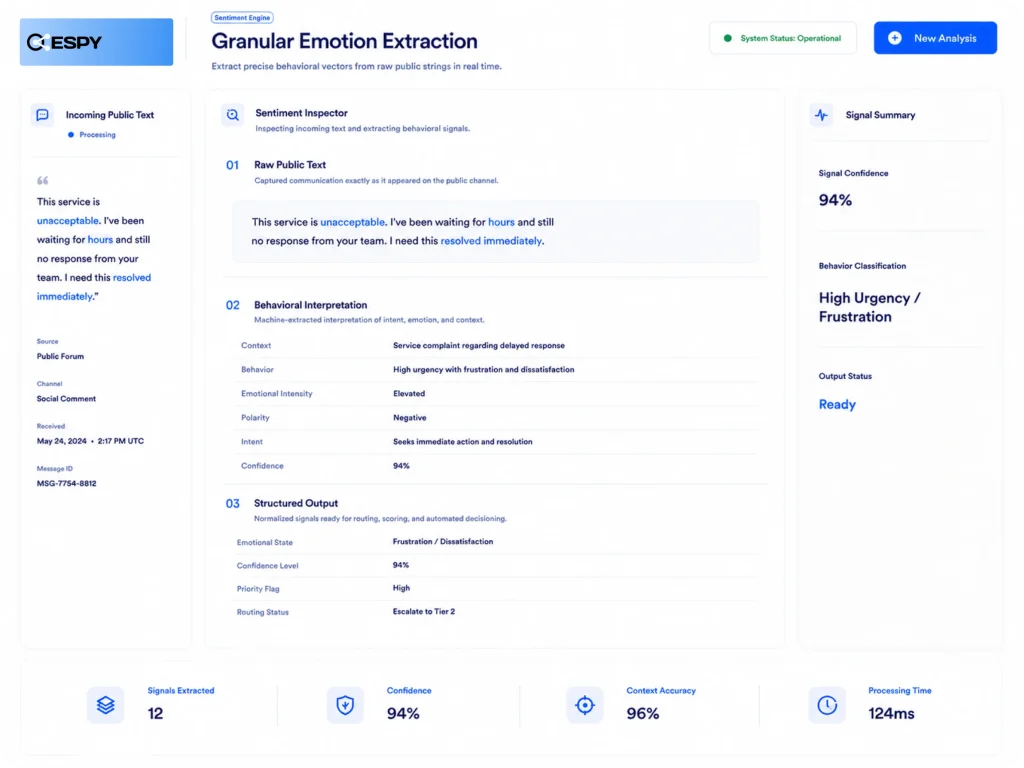
Granular Emotion Extraction

Stream real-time sentiment analysis on negative news and adverse entity coverage directly into internal KYC/AML onboarding workflows. Returning precise data arrays at sub-100ms query latency allows your risk engines to automate background profiling without manual review overhead.

  • Targeted Behavioral Classification: Maps specific emotional states-including urgency, frustration, skepticism, and alignment-directly into your metadata payload.

  • Automated Logic Triggering: Delivers predictable string variables, allowing internal risk and routing engines to execute automated actions without manual review load.

  • Contextual Polarity Verification: Validates word context to ensure sharp polarity scoring, preventing conversational noise from distorting core compliance fields.

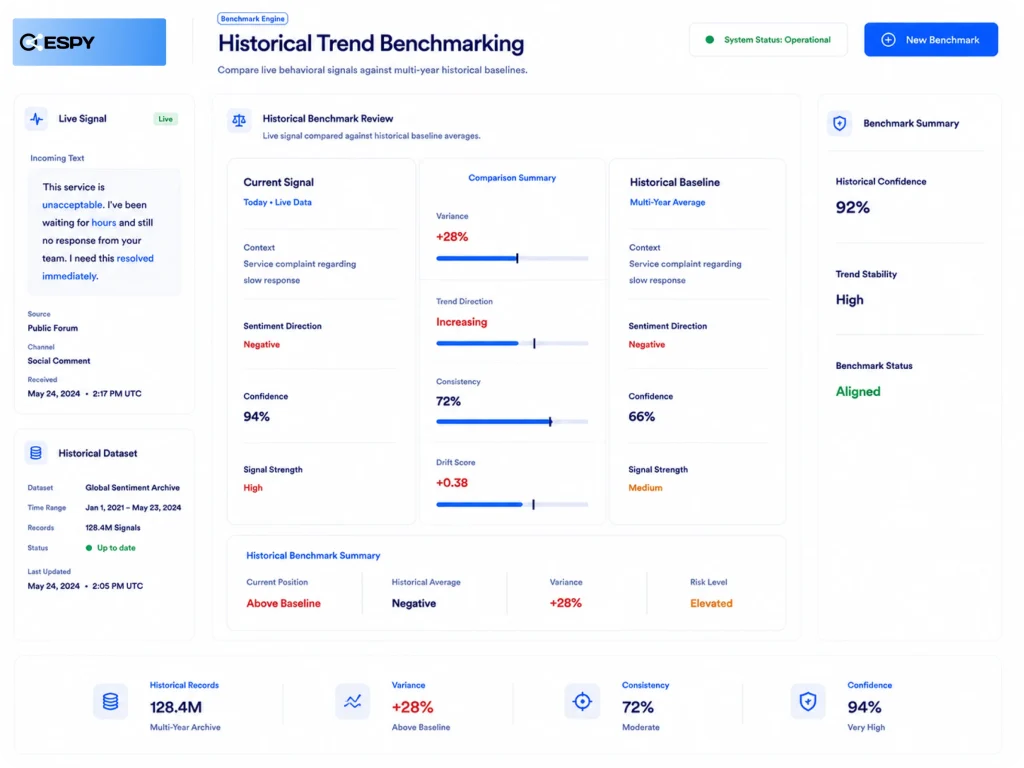
Historical Trend Benchmarking

Isolating a single moment in time does not provide enough context for risk modeling. The pipeline leverages automated sentiment analysis across public web networks and forums to detect sudden surges in negative merchant sentiment, chargeback threats, or fraud indicators before they impact your portfolio.

  • Macro Variance Tracking: Compares current token scores against historical baseline averages to surface significant network anomalies or macro sentiment shifts.

  • Entity Health Arrays: Provides structured historical data arrays for specific brands, merchants, or corporate entities, feeding deep trend lines into your risk database.

  • Dynamic Delta Scoring: Computes the mathematical variance between live sentiment analysis data and historical curves for accurate, automated risk projections.

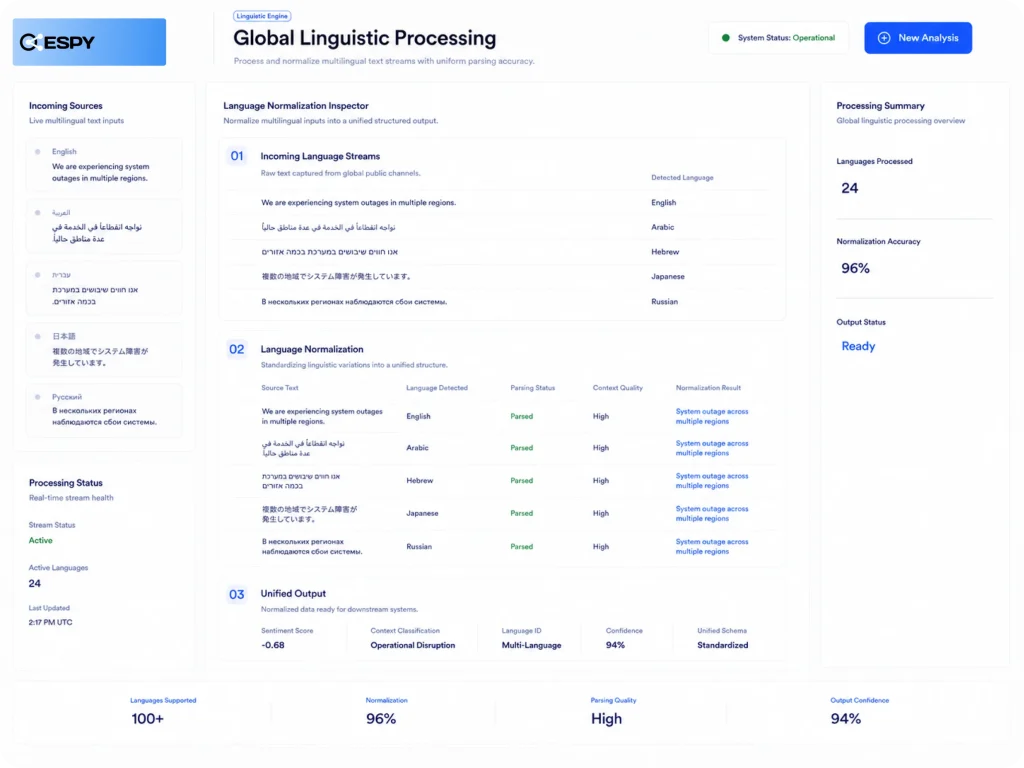
Global Linguistic Processing

Public text streams and digital conversations cross regional boundaries constantly. Deploy sentiment analysis velocity metrics and behavioral text parsing across digital footprints to isolate synthetic profiles, automated spam bots, and malicious registration spikes.

  • 100+ Languages (Direct Native Processing): Analyzes text directly in its original language without intermediate English translation layers. Preserves exact linguistic context, regional slang, and subtle tone across global text streams.

  • Cross-Market Normalization: Standardizes sentiment analysis scores across different language streams, ensuring a unified data output format regardless of the source.

  • Platform-Agnostic Parsing: Maintains uniform parsing fields across all source types, from short-form network logs to long-form media archives.

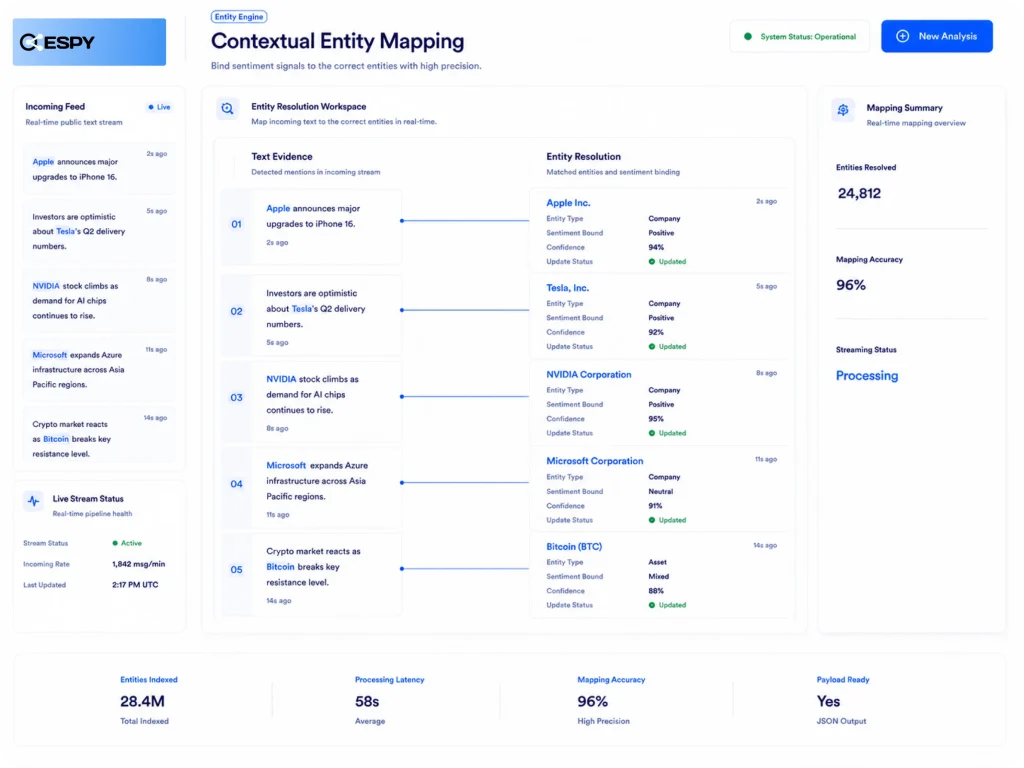
Contextual Entity Mapping

Raw sentiment analysis is only valuable if it is accurately attributed to the correct entity. The pipeline indexes web-scale text streams in under 60 seconds, binding calculated emotional vectors and open-source conversation metadata directly into proprietary case management systems for forensic-grade risk analysis.

  • Target Attribution Logic: Binds every computed sentiment score to the exact keyword, brand name, or individual identified in the raw text block.

  • Sub-60s Streaming Velocity: Processes and updates incoming network feeds within 60 seconds, ensuring your data tier reflects current public network activity.

  • Clean Payload Delivery: Outputs data directly into your enterprise pipeline as a schema-valid JSON object, eliminating internal data reformatting layers.

Programmatic Sentiment Ingestion Across Core Industries

Stream raw sentiment metadata directly into your existing infrastructure. ESPY provides the programmatic layer necessary to automate risk validation, filter environmental noise, and feed predictive scoring models without manual pipeline overhead.

Core Pipeline Normalization: ESPY aggregates publicly available web infrastructure data and open-source networks without storing unauthorized PII. The pipeline processes raw data arrays using live crawling loops, ensuring your internal data tier aligns with global compliance frameworks.

Predictive Sentiment Response Schema & Parameters

Consistent, schema-valid JSON delivered on every database endpoint inquiry. Code integration requires zero client-side filtering layers, providing predictable response structures designed for enterprise pipelines.

Sentiment Analysis Data API

Structured Sentiment Data Output Specifications

Web-scale text streams and adverse media sources are processed through multiple contextual filters. The API normalizes raw public chatter and news subnets into machine-readable parameters, allowing internal risk engines to ingest structured sentiment analysis and compliance vectors natively.

Polarity Mapping

Calculates exact emotional trajectory on a normalized scale, allowing risk engines to distinguish benign community alignment from high-priority complaints without client-side parsing overhead.

Subjectivity Analysis

Distinguishes subjective rants from objective news and corporate filings, stripping out conversational noise before text streams reach your internal models.

Behavioral Category Logic

Parses unstructured strings into standardized behavioral vectors, instantly flagging high-risk states-like escalation intent, severe frustration, and hostility-for automated queue routing.

Contextual Sarcasm Auditing

Uses contextual embeddings to read surrounding text patterns, identifying when positive terms are used mockingly or cynically to eliminate false positives in your data outputs.

Velocity & Spike Telemetry

Tracks the chronological expansion rate of a discussion topic against multi-year baseline trends, triggering automated alerts the moment conversation frequency surges past standard parameters.

Platform-Agnostic Normalization

Standardizes diverse open-source data formats into one single, predictable schema-valid JSON object, making the text fields instantly routable within CRM, SIEM, or risk pipelines.

The Public Network Pulse Layer: Automated Sentiment Scanning

Scale across global networks without manual data monitoring. ESPY supplies an elastic, high-throughput scanning layer that parses public text streams, automatically identifying behavioral shifts and delivering normalized analysis directly into your backend architecture.

60s

Processing Velocity

10M+

Strings Scored Daily

100+

Languages Native Support

The baseline pulse engine evaluates data consistency across international networks, leveraging distributed crawler nodes to access open-source chatter and localized public media streams. It computes dynamic sentiment velocity and spike telemetry to flag immediate compliance risks, fraud anomalies, and entity risk factors. Engineered for enterprise high-velocity systems, the API outputs schema-valid JSON to drive automated decisioning at massive scale.

Score, Attribute, and Segment Sentiment Text

ESPY handles the engineering overhead of parsing unstructured public spaces, converting raw text streams into clean, machine-readable data structures designed for corporate intake and automated routing.

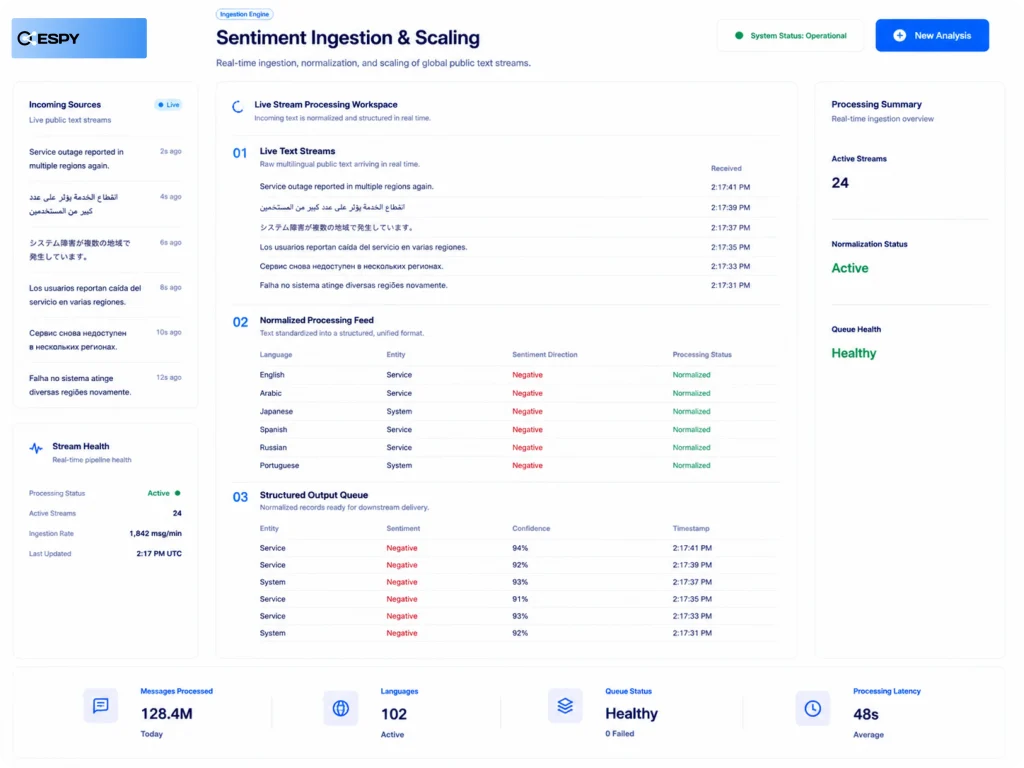
Sentiment Ingestion & Scaling

  1. Global Text Normalization: Processes inputs across 100+ native language engines to maintain baseline structural consistency.

  2. Aspect-Based Extraction: Surfaces specific emotional vectors directed at features, brands, or entities from public network chatter.

  3. Velocity Tracking Routine: Matches raw message volume spikes against historical data to flag unusual narrative expansions.

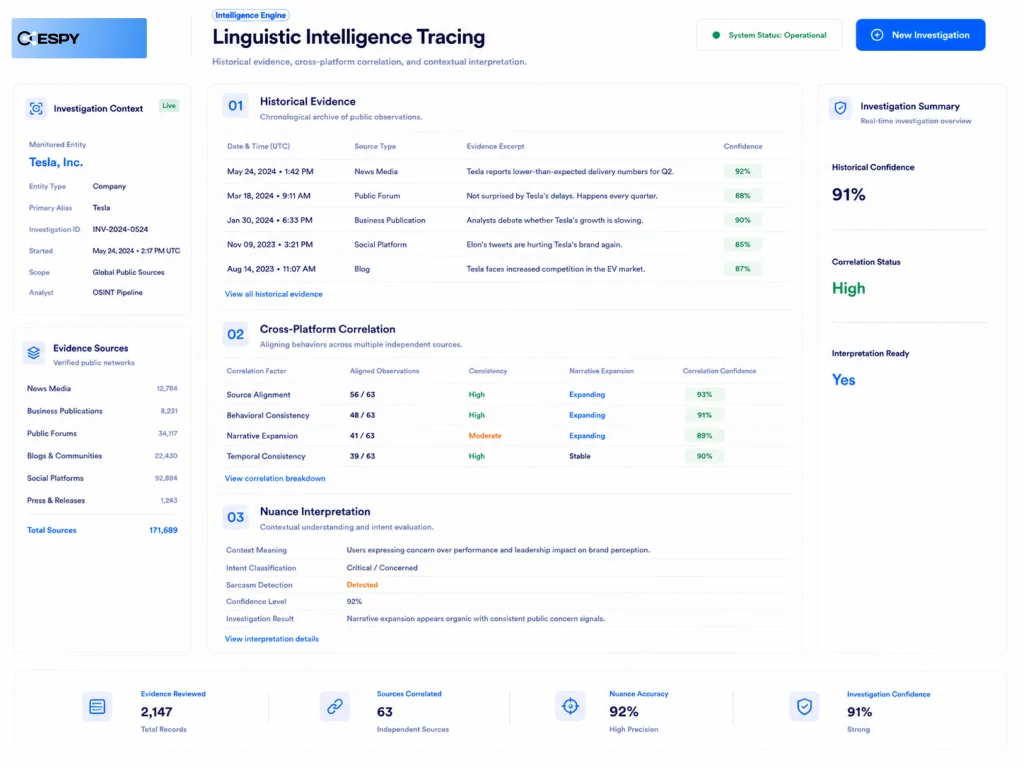
Linguistic Intelligence Tracing

  1. Long-Term Benchmarking: Evaluates sentiment performance shifts over years to support deep forensic brand health reviews.
  2. Cross-Platform Linkage: Maps coordinate behaviors across separate networks to determine whether trend expansion is organic.
  3. Nuance Detection Indexing: Evaluates contextual terms to extract true user intent behind sarcastic or deceptive phrasing.

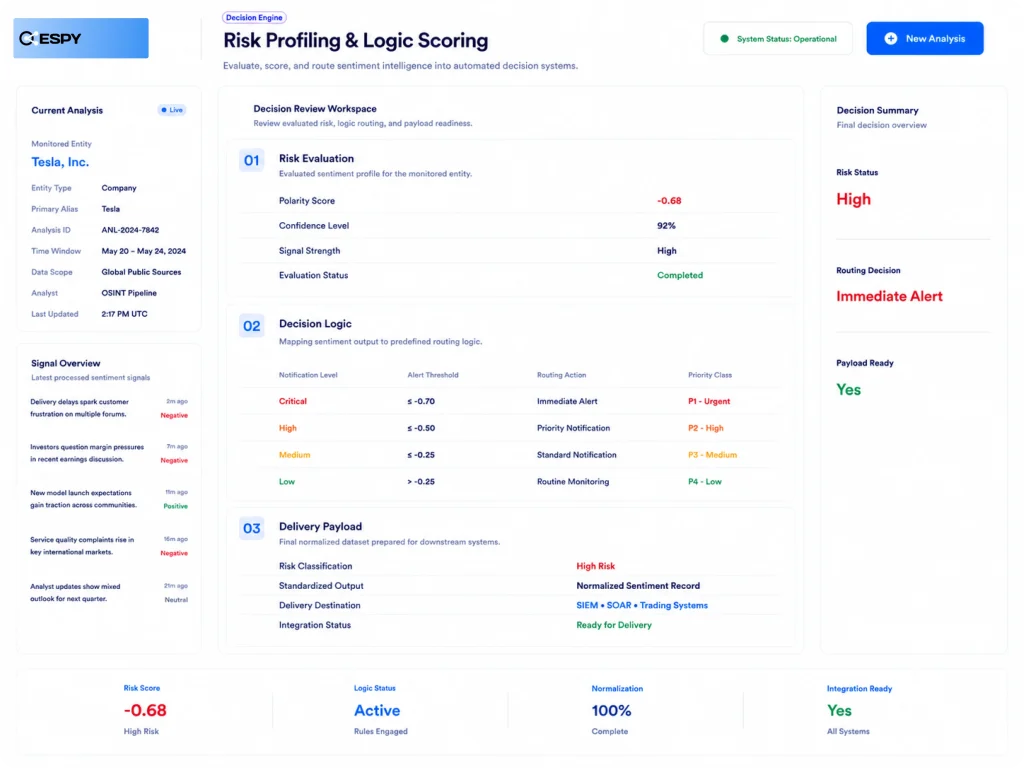
Risk Profiling & Logic Scoring

  1. Numeric Polarity Logic: Computes mathematical polarity values to drive automated platform notification and routing layers.
  2. Crisis Trigger Routing: Automates early-warning system flags the moment high-urgency negative anomalies cross strict thresholds.
  3. Pipeline Normalization: Formats sentiment datasets into standardized payloads ready for SIEM, SOAR, or internal risk scoring systems.

Why Technical Leaders Choose ESPY Sentiment Analytics

Traditional tools rely on rigid keyword matching that misses the true driver behind public messages. ESPY delivers real-time emotional metadata and context-aware payloads designed for high-performance enterprise systems.

Traditional Lookup Tools

ESPY Sentiment Data API

Enterprise-Grade Data Provenance

The data infrastructure behind real-time sentiment analytics.

ESPY provides the underlying data infrastructure that powers high-volume corporate intelligence. Instead of analyzing text in isolation, our platform connects public text streams directly to global data records and historical baselines. This ensures that every sentiment score and velocity alert we deliver is backed by verified, web-scale database integrity.

We build for data engineers, risk analysts, and enterprise platforms that require clean, schema-valid data feeds to automate critical decisions with zero operational friction.

Trusted by developers, system architects, and trust and safety teams worldwide.

Ronald Richards

CEO & Founder

Data Feed Workflow & System Integration

The ESPY sentiment pipeline queries public databases and routes structured emotional metadata directly into your infrastructure in seconds.

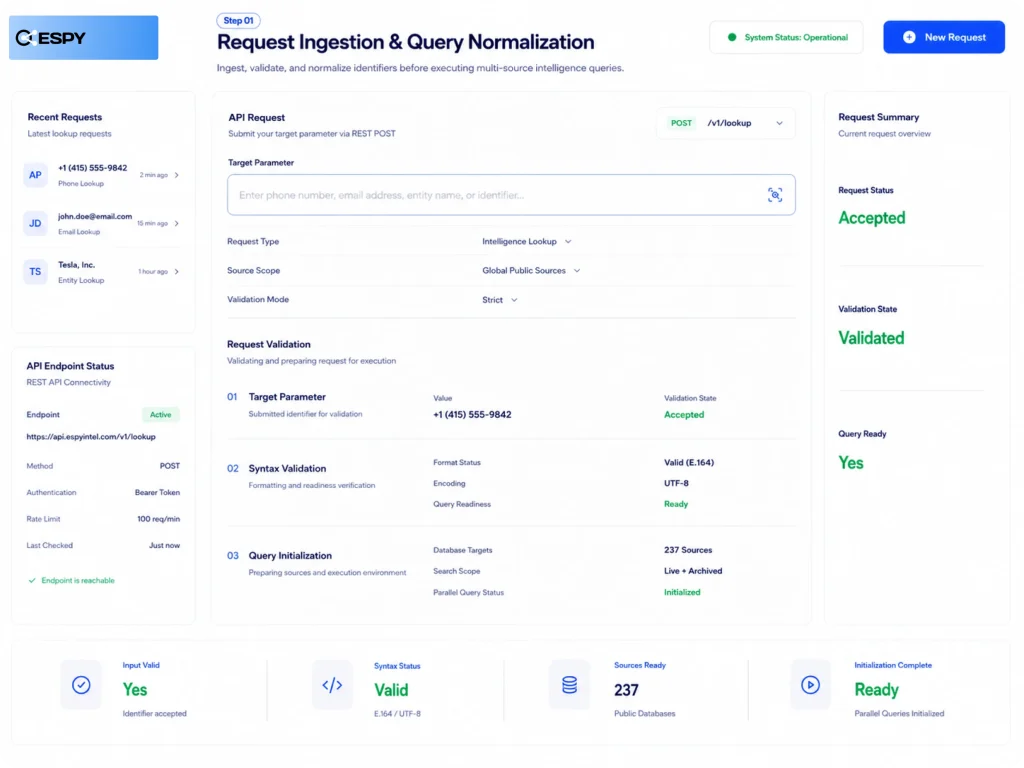
Request Ingestion & Query Normalization

  1. Target Parameter Ingestion: Transmit your target keywords, entities, or strings through a secure REST API POST request.

  2. Syntax Validation: The endpoint performs immediate formatting checks to prepare the identifier for multi-source database queries.

  3. Pipeline Initialization: The system opens parallel processing threads to scan live public networks and indexed archives simultaneously.

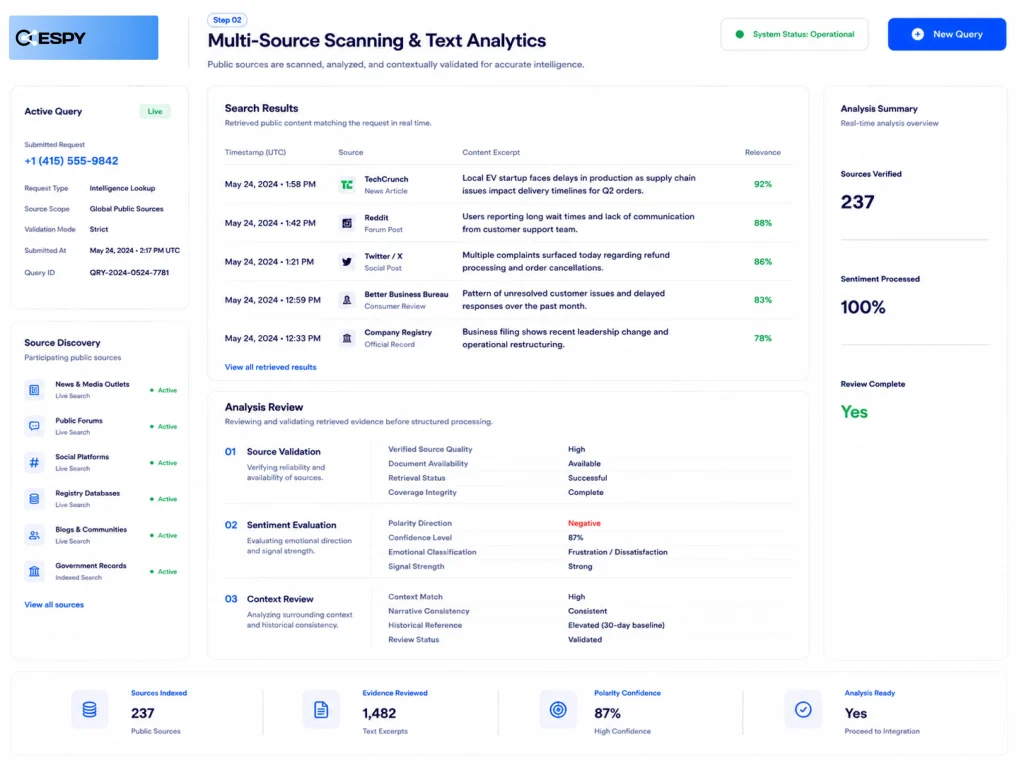
Multi-Source Scanning & Text Analytics

  1. Public Database Interrogation: The engine queries unstructured open-source channels, forums, and registries for matching text strings in real time.
  2. Mathematical Polarity Scoring: Evaluates retrieved text against standardized metrics to compute precise emotional direction vectors.
  3. Contextual Auditing: Scans surrounding sentence structures and volume fluctuations against multi-year baselines to eliminate false risk signals.

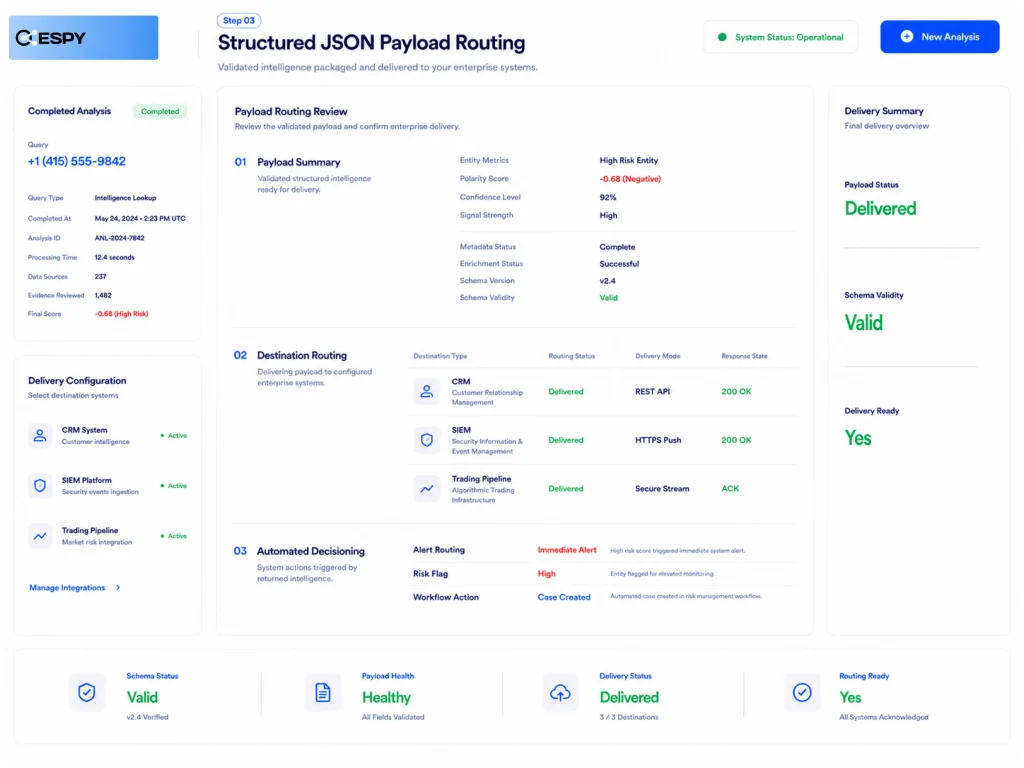
Structured JSON Payload Routing

  1. Schema Validation: Organizes all extracted metadata, polarity scores, and entity metrics into one single, valid JSON object.
  2. Infrastructure Deployment: Delivers the validated payload directly into internal enterprise environments like CRM, SIEM, or risk decision engines.
  3. Automated Decisioning: Enables immediate, data-driven system alerts and logical routing actions based on the returned scores.

ESPY Sentiment Data API vs. Traditional Methods

Most tools provide basic keyword counting across cached datasets. ESPY delivers real-time, multi-platform data streaming backed by strict mathematical polarity and risk scoring.

Feature Traditional Reverse Search Standard OSINT Tools Manual Web Monitoring
Real-time carrier mapping
Via Metadata
Cross-platform profile matching
Via Transforms
Identity & alias discovery
VoIP & virtual line detection
Built In
Core Feature
Live reputation scoring
Partial
Limited
Connected footprint mapping
US only

US only

Automated data pipelines

Paid

Global registry scanning
Add-on
No technical skills needed
Requires Training
Free trial access
No Card Needed
Limited
Limited
Limited

Trusted by Data-Driven Platforms

How engineering, quant, and risk teams integrate the ESPY Sentiment API to automate high-volume text ingestion and database scoring.

We hooked the ESPY sentiment feed directly into our high-frequency execution models. Because it bypasses typical search engine delays and queries public databases in real time, our systems catch retail volume shifts well before they impact price charts.

Aris T.

Head of Quantitative Strategy

We were maintaining expensive internal scrapers to track trends across unindexed boards and networks. Moving to ESPY allowed us to decommission that infrastructure completely and rely on a single, unified data feed.

Lucas M.

Director of OSINT Engineering

Most sentiment feeds require massive internal cleaning. ESPY streams flat, schema-valid JSON structures that dropped into our Snowflake data warehouse in less than an hour. Zero manual parsing friction.

Nikolai V.

Principal Data Architect

The aspect-based tracking is where ESPY delivers the highest fidelity. We don’t just get a generic score for a post; the payload maps the sentiment directly to a specific product attribute or corporate entity.

Kenji T.

Lead Analytics Engineer

The sarcasm filter isn’t just marketing text. Our internal testing showed a 40% reduction in false-positive risk alerts compared to our previous keyword matching setup, meaning fewer dead-end alerts for our triage team.

Ethan C.

Senior Solutions Engineer

In crisis mitigation, a 24-hour delay is useless. ESPY’s sub-60s pipeline latency means our automated enterprise defense networks receive real-time alerts the moment high-volume negative spikes cross our risk threshold.

James P.

VP of Threat Intelligence

Handling text tracking across multiple regions used to mean building separate translation pipelines. ESPY standardizes polarity metrics across 100+ native languages directly at the ingestion layer, saving us massive compute costs.

Haruto N.

Global Compliance Systems Architect

Frequently Asked Questions

Everything you need to know about global sentiment data infrastructure, metrics parsing, and technical API integration.

Does sentiment analysis violate user privacy?

No. The ESPY Sentiment Data API only queries public data records, open discussion networks, indexed web archives, and global registries. The pipeline does not access or store private communications, and all returned payloads contain aggregated or strictly public-domain text data.

Our mathematical scoring filters analyze surrounding context and comparative text patterns rather than isolated keywords. By evaluating sentence structure and modifying words, the system filters out conflicting emotional cues to minimize false-positive risk flags.

The ESPY Sentiment Analysis API is built specifically for tech teams and enterprise architects. The RESTful API outputs standardized, schema-valid JSON payloads engineered for direct programmatic ingestion into proprietary risk scoring models, CRMs, SIEM architectures, and internal fraud pipelines.

Yes. The API delivers raw payloads as standardized, schema-valid JSON objects. This flat structure integrates natively with enterprise environments, risk monitoring pipelines, and data warehouses like Snowflake without requiring custom ingestion scripts.

The system monitors live web streams and database records with a pipeline latency of sub-60 seconds. This ensures that sudden shifts in public sentiment or risk surges are processed and available in the data feed almost immediately.

Score with Confidence. Analyze Sentiment with ESPY

Access our structured data feeds to monitor public text streams, retrieve real-time polarity analytics, and route risk metrics through a unified API architecture.

Related Guides

The Missing Piece in Modern Background Checks

Imagine you are about to hire someone, rent out a property, choose a contractor, or enter

How to Do Reverse Phone Lookup: A Practical Guide to Checking an Unknown Number

An unfamiliar number can be a nuisance or the first clue in a fraud review, customer

How to Maximize OSINT With Cognyte Analytics: A Practical Investigation Workflow

Poorly prepared information can weaken an investigation before analysis begins. Investigators studying how to maximize OSINT