













Facial Recognition Data API &
Reverse Image Search

ESPY’s Facial Recognition Data API delivers high-confidence visual identity resolution for modern platform integration. Powered by the IRBIS AI engine, the system cross-references biometric signals against all available social networks and a vast amount of public web sources to surface  identity information in seconds via a secure RESTful API. Built as a scalable data infrastructure, our platform helps developer teams and enterprise organizations seamlessly enrich data networks and connect visual components with real-world digital profiles.

97%

Match accuracy

Public Only

Sources scanned

200+

Countries covered

Face detected
97% confidence
3 matches found
Facial Recognition Scan
IRBIS AI Engine
Complete
Facial recognition scan subject EYE-L EYE-R confidence: 97%
LinkedIn
linkedin.com/in/j-anderson
97%
Twitter / X
twitter.com/janderson
91%
News Archive
reuters.com/article/j-anderson
84%

Beyond Static Databases: The Power of Web‑Scale Face Matching

Most facial recognition tools rely on limited, static datasets. ESPY expands far beyond those boundaries, allowing platforms to automatically link physical faces to digital identity records across the open web and public networks.

Massive Visual Indexing

Query biometric signatures against an extensive web-scale archive derived from public directories, news outlets, and all available social networks worldwide.

Unstructured Web Extraction

Our infrastructure scans raw public data, open forums, and historical web archives that traditional search engines fail to map, uncover, or extract.

IRBIS AI Feature Correlation

The IRBIS AI core engine compares unique biometric patterns to find high-confidence matches, maintaining resolution accuracy even across historical or lower-quality source images.

More Than Image Search. Built for Facial Intelligence.

ESPY combines facial analysis, cross-platform mapping, and open-source data ingestion into a unified data infrastructure for developers.

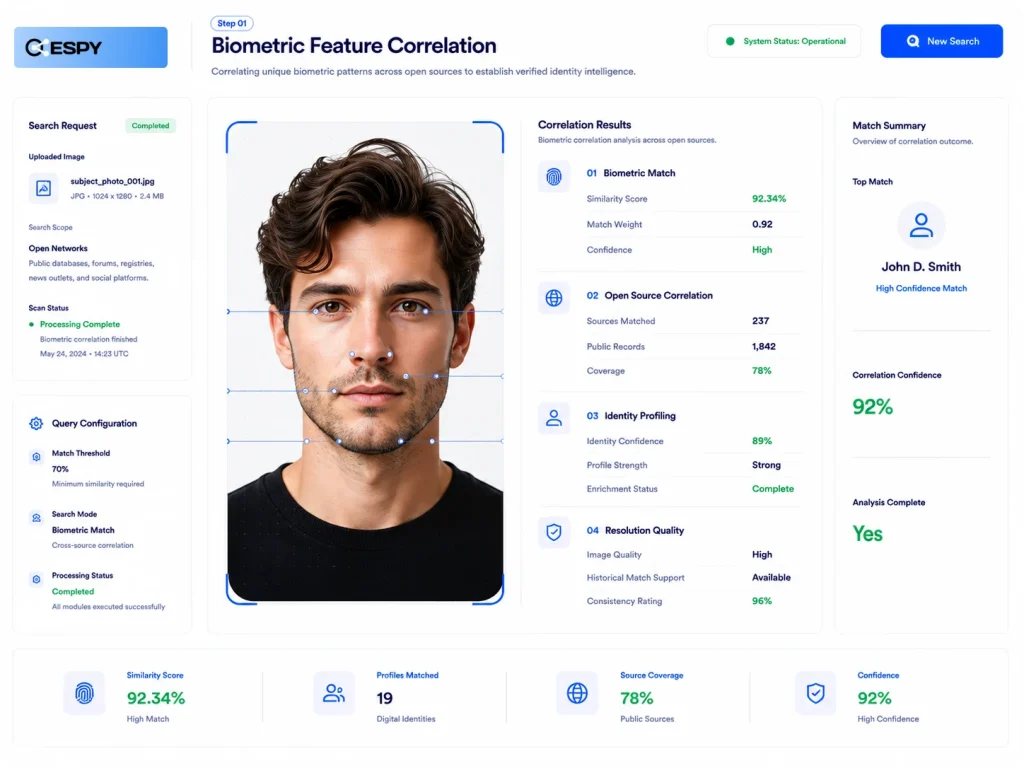
Biometric Feature Correlation

The IRBIS AI core engine compares unique biometric patterns to establish verified data links across open networks. The platform maintains resolution consistency even when evaluating historical records or low-resolution source files.

  • Probabilistic Matching: Receive numerical similarity percentages and match weights designed for automated threshold evaluation.

  • Open Source Extraction: Map visual components against raw public endpoints that traditional web indexes cannot process.

  • Identity Profiling: Form structural connections between raw visual queries and real-world digital profiles via automated data enrichment.

Web-Scale Ingestion & Massive Indexing

Go beyond standard reverse image lookups. ESPY provides an enterprise data pipeline that queries public web archives and all available social networks to extract visual components, linking single image files to verified data inputs.

  • Public Web Ingestion: Access open professional directories, public registries, and historical platform archives.

  • Global Footprint Mapping: Scan billions of public endpoints spanning global news sources and available open platforms.

  • Unified Profile Resolution: Link raw visual query inputs with alternative public metadata traces and digital signatures.

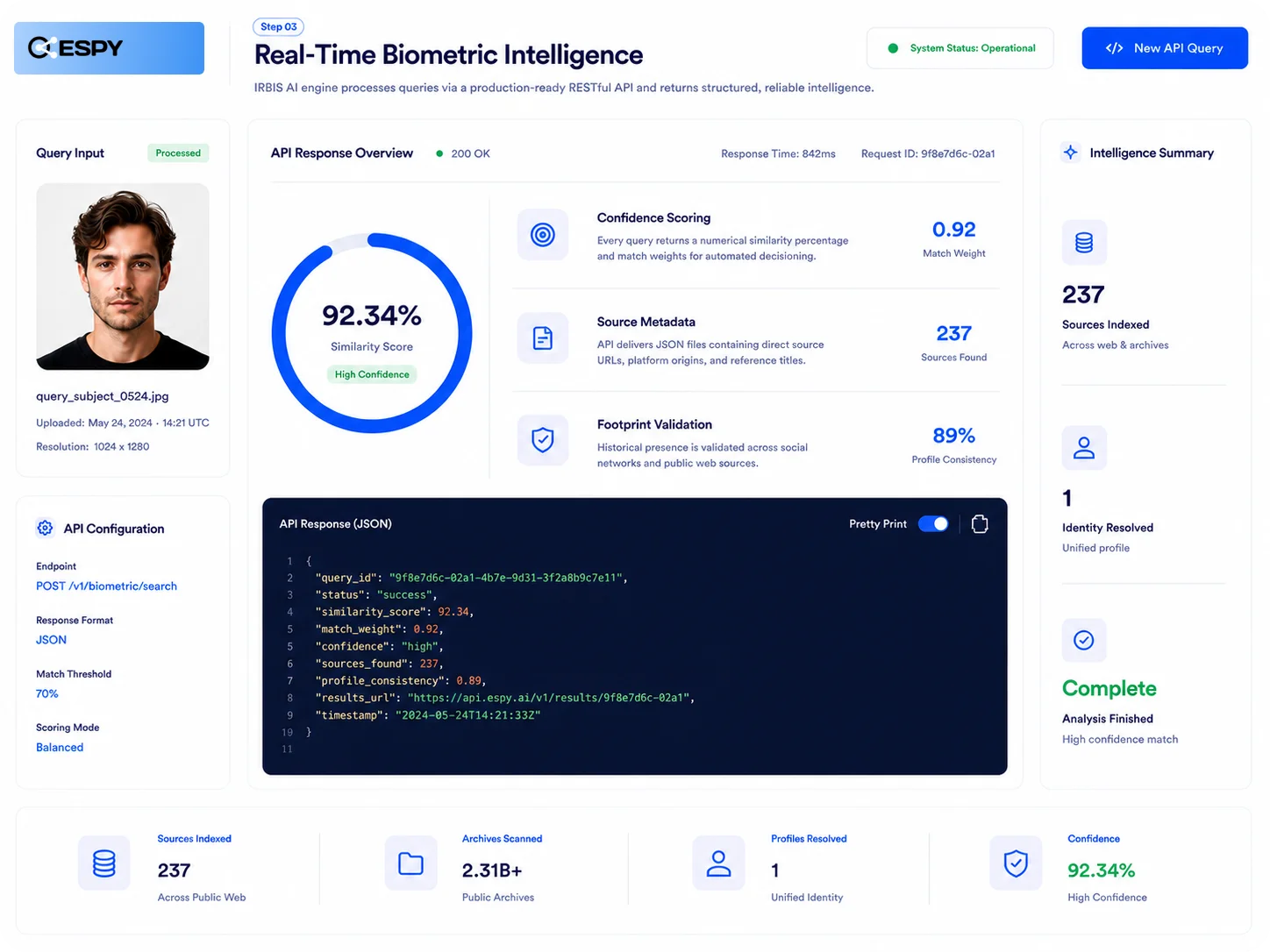
Real‑Time Biometric Intelligence

The IRBIS AI engine processes queries via a production-ready RESTful API, delivering clean data outputs optimized for automated evaluation and enterprise-grade deployment.

  • Confidence Scoring: Every query returns a numerical similarity percentage and match weights, allowing platforms to establish automated filter thresholds.

  • Source Metadata: API responses deliver JSON files containing direct source URLs, platform origins, and reference titles for verification.

  • Footprint Validation: The system checks historical presence across all available social networks and public web sources to verify profile consistency over time.

Strategic Industry Solutions

ESPY provides the infrastructure and visual identity resolution tools necessary to connect visual inputs with verified identity records across public platforms. Built for integration, our platform supports high-throughput verification pipelines across multiple production workflows.

  • KYC & Identity Platforms: Run identity validation workflows by verifying that registration images or user selfies correspond with a verifiable public online footprint.

  • Risk & Fraud Mitigation: Detect synthetic identity fraud and profile spoofing by cross-referencing incoming visual inputs against global public data networks.

  • Trust & Safety Teams: Maintain ecosystem integrity by verifying user accounts against public professional records, reducing credential manipulation and automated bots.

Strategic Biometric Infrastructure for Enterprise

We provide the data layer and logic necessary to integrate visual identity resolution into existing platform tech stacks, supporting automated checks across multiple enterprise workflows.

Need to start with limited parameters? IRBIS AI can enrich user profiles and discover connections using a single photo, email, or digital signature via a unified API endpoint.

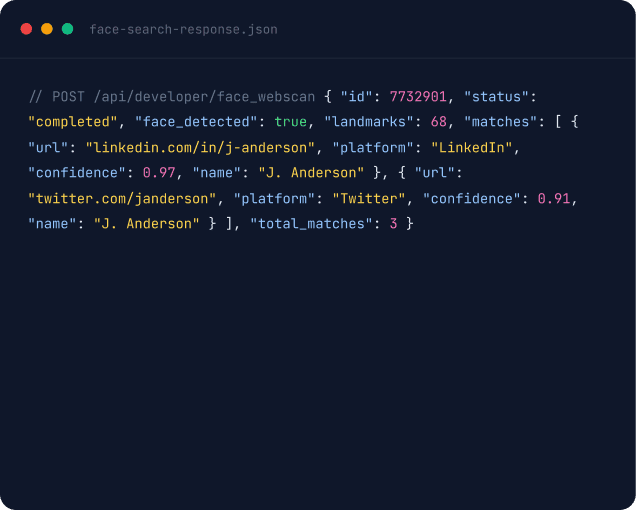
Every field returned by the Facial Recognition Data API

High-performance visual queries delivered in a clean JSON response, optimized for real-time operations where speed is critical.

What Can Facial Recognition Reveal Beyond a Match?

Facial recognition is more than image comparison; it is a gateway to deep biometric intelligence. ESPY’s infrastructure helps investigators uncover complex identity patterns, connected aliases, and hidden digital footprints that remain invisible to standard tools.

Identity Resolution

Submit a single photo query to map an individual's public online footprint. The system cross-references biometric signals to identify related profiles and matching source networks worldwide.

Deep Web Vision

Reach beyond indexed platforms. Our system uncovers facial data in non-indexed forums and archives that standard search engines cannot access.

Fraud & Synthetic Detection

Distinguish real human identities from synthetic patterns. Historical validation checks for a verifiable presence across multiple networks over time to combat deepfakes.

Digital Footprints

Connect raw visual inputs with verified identity data. Map individual records across all available social networks and global public directories to populate missing metadata and profile fields.

Real-Time Monitoring

Run blacklist enforcement and suspect tracking. Receive immediate alerts when new visual references appear across monitored intelligence sources.

Relationship Mapping

Integrate public platform links, user profiles, and visual components into instant validation workflows. Every response delivers contextual metadata and verified source URLs in a clean JSON format.

Uncover Connected Identities Across Images, Profiles, and Digital Sources.

ESPY’s Biometric Data Infrastructure helps enterprise platforms and developer teams cross-reference visual data with verified online records. Built as a scalable data pipeline, the system transforms raw image components into clear metadata signals for platform trust and safety workflows.

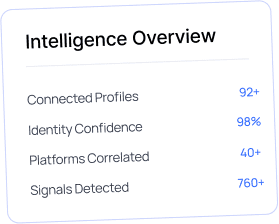
1.4B+

Profiles Indexed

40+

Intelligence Sources

200+

Countries Covered

ESPY core analysis platform evaluates biometric patterns across all available social networks, public web archives, and professional directories to map digital footprints and link identity markers. Engineered for technical leaders, the architecture combines a high-performance RESTful API with automated validation pipelines to deliver verified, instant results.

Search, Match, and Resolve Identity Signals

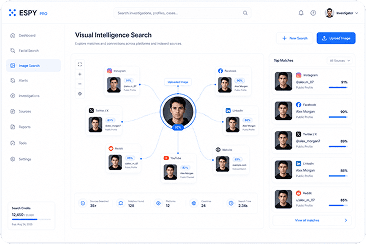
ESPY provides the data infrastructure necessary to connect visual records with verified digital footprints. Our platform combines high-precision facial matching and open-source discovery to streamline complex workflows into a unified, developer-ready interface.

Facial Identification

  1. Detect and match unique biometric patterns across the public web using uploaded photos, screenshots, or system files.

  2. Map connected profiles, alternative metadata, and historical online presence to bridge the gap between a raw query input and a verified user account.

  3. Maintain system accuracy even when analyzing historical, low-resolution, or partially obscured images through advanced intelligent validation.

Visual Intelligence

  1. Parse unstructured datasets by accessing a comprehensive visual index compiled from all available social networks and global news outlets.

  2. Access open web archives and non-indexed directories to reference visual records that traditional search engines cannot process.

  3. Enrich platform records by linking physical face queries to multi-platform accounts, usernames, and public registries across the web.

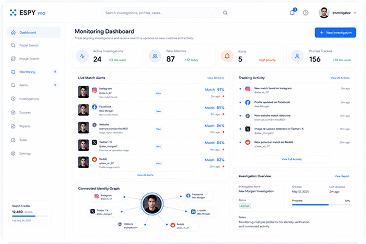
Monitoring & Tracking

  1. Continuous identity consistency checks and receive instant alerts whenever new visual references or matching profiles appear across monitored online sources.

  2. Distinguish legitimate human profiles from synthetic fraud patterns and generative media through historical profile validation.

  3. Streamline enterprise compliance operations, fraud detection workflows, and trust and safety audits with reliable data delivery.

Why Technical Leaders Choose ESPY

Traditional image search tools rely on limited, static datasets that only find surface-level matches. ESPY provides the data layer and logic necessary to link visual evidence to verified digital identities across the open web.

Traditional Lookup Tools

ESPY Facial Recognition Data API

Intelligent Biometric Infrastructure

Automated Profile Verification Across Global Social and Corporate Networks

ESPY turns scattered digital signals into clear, verified records using advanced cross-platform matching. By connecting raw images to public profiles and corporate registries, we provide the data engineers need to build reliable validation systems. Built for scale, ESPY combines identity matching and history checks into a single, automated workflow that fits right into your existing platform.

Trusted by developers, system architects, and trust and safety teams worldwide.

Ronald Richards

CEO & Founder

How ESPY Biometric Intelligence Workflows Work

Connect facial matching and global identity verification to your system in minutes. ESPY gives teams the pipelines to link profiles and verify images automatically, no matter the volume.

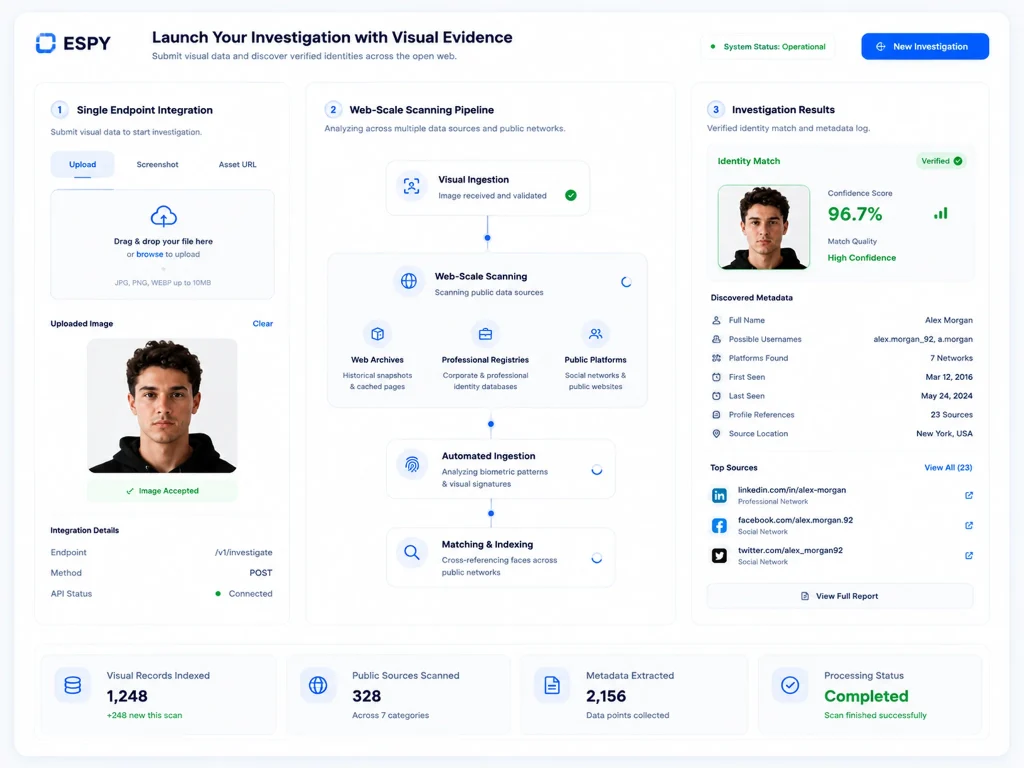
Launch Your Investigation with Visual Evidence

  1. Submit Visual Data: Upload a profile photo, screenshot, or digital asset to our Single Endpoint Integration.
  2. Web-Scale Scanning: The platform scans public web archives, corporate professional registries, and available online platforms to reference visual records.
  3. Automated Ingestion: The system analyzes unique biometric patterns to match faces across public networks and deliver detailed metadata logs.

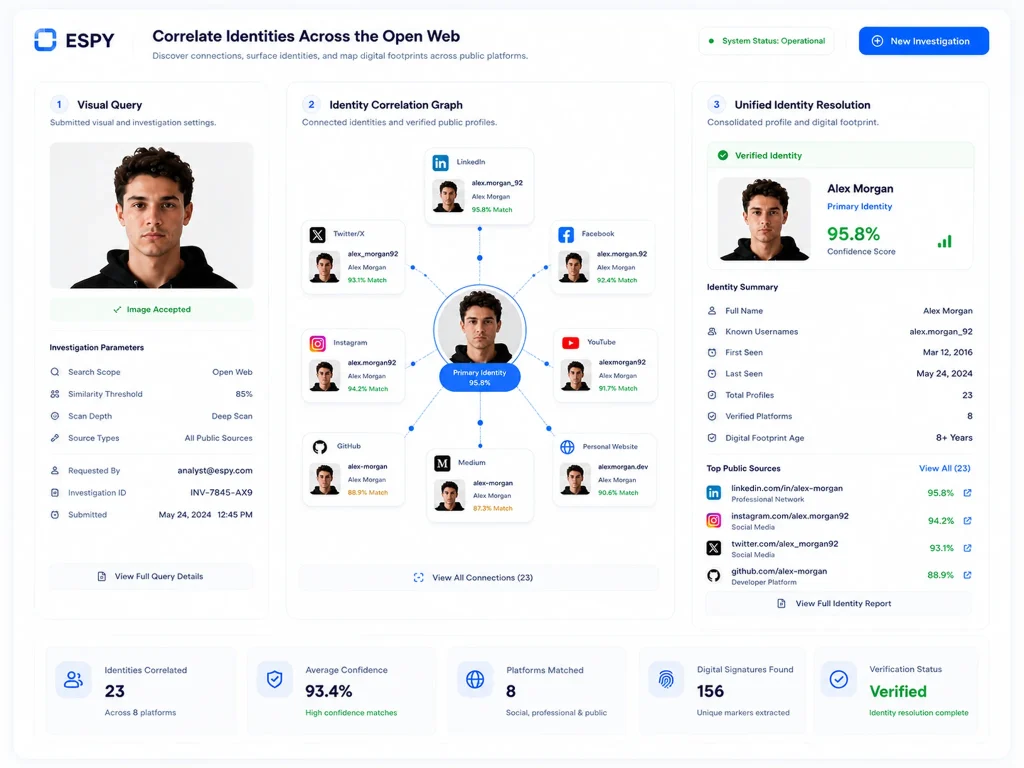
Correlate Identities Across the Open Web

  1. Identify Connections: Discover matching profiles across all available social networks to surface usernames, platform origins, and historical online activity.

  2. Confidence Scoring: Review precise similarity metrics, percentage scores, and contextual data to align each query with verified online footprints.

  3. Public Source Expansion: Leverage advanced indices to extract hidden visual markers and digital signatures that traditional search engines miss.

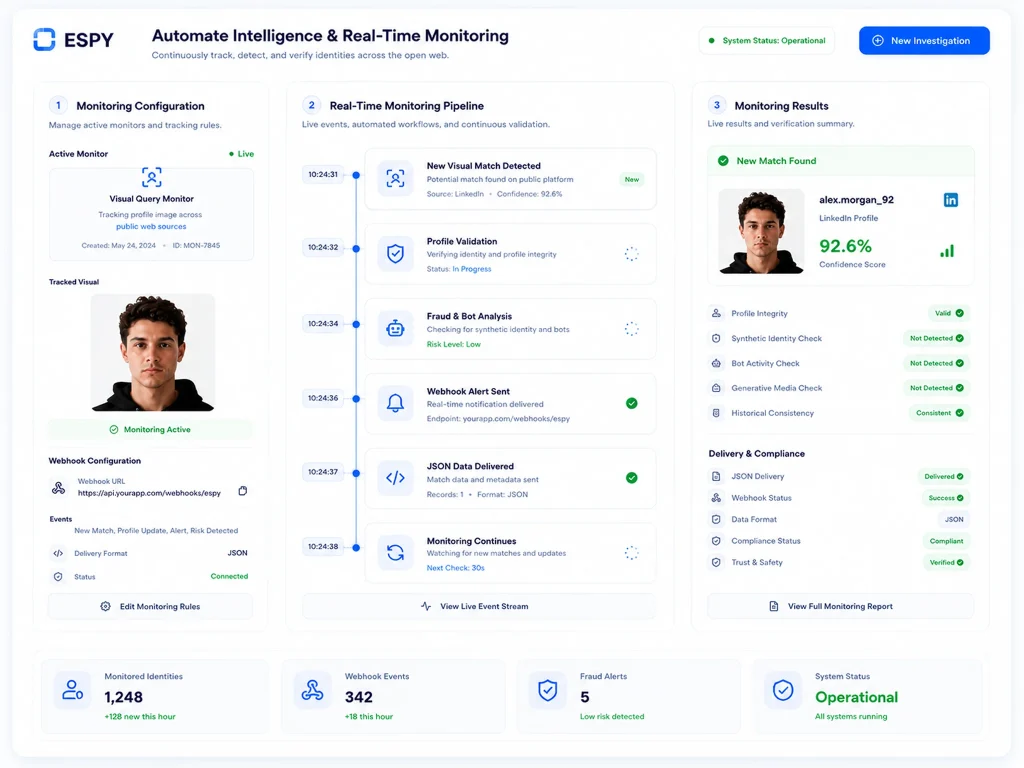
Automate Intelligence & Real-Time Monitoring

  1. Real-Time Tracking: Monitor specific visual queries across public channels and receive automated webhook alerts whenever new matching profiles appear.

  2. Profile Integrity: Distinguish human profiles from synthetic fraud patterns, automated bots, and generative media through continuous historical validation.

  3. System Optimization: Streamline enterprise compliance operations, fraud mitigation pipelines, and trust and safety audits with JSON data delivery.

ESPY Facial Search vs Traditional Image Tools

Most reverse image tools only provide basic, surface-level matches. ESPY provides the data layer and logic necessary to connect visual evidence with verified digital identities into one unified intelligence platform.

Feature Traditional Reverse Search Standard OSINT Tools Manual Verification
Biometric face matching
Via Metadata
Cross-platform profile matching
Via Transforms
Identity & alias discovery
Repeated image detection
Built In
Core Feature
Real-time monitoring alerts
Partial
Limited
Connected identity mapping
US only

US only

Investigation workflows

Paid

Public & indexed source scanning
Add-on
No technical skills needed
Requires Training
Free trial access
No Card Needed
Limited
Limited
Limited

Trusted by Industry Service Providers

How technical leaders integrate the ESPY Biometric Data API to power their own identity and security solutions.

By integrating our API, KYC providers can now offer high-precision facial matching across non-indexed web sources, significantly reducing manual review times for their end clients.

David Kim

CEO At Spectrum

Access billions of visual data points from non-indexed forums, professional directories, and public records to uncover links that traditional search engines cannot reach.

James Parker

Operations Lead

Security vendors use ESPY’s data layer to detect synthetic patterns and deepfakes. This adds a critical level of historical validation to their existing threat detection suites.

James Parker

Operations Lead

Built for developers. Our single-endpoint integration allows service providers to scale their identity intelligence capabilities without complex infrastructure overhead.

Ethan Carter

Product Designer

Verify the longevity and authenticity of digital footprints. Our historical index allows providers to distinguish between established accounts and newly created malicious profiles.

Carlos Rivera

Global Project Manager

Anti-fraud service providers leverage our visual intelligence to map relationship networks between fragmented digital identities, providing their users with a more complete risk profile.

Liam Scott

Operations Director

Specialized compliance firms integrate our biometric infrastructure to run real-time blacklist enforcement, ensuring their clients meet strict international regulatory standards.

Liam Anderson

CEO At Apex

Frequently Asked Questions

Everything you need to know about biometric infrastructure, identity intelligence, and technical integration.

How does the facial recognition search work?

You submit a photo via the IRBIS API. The AI maps facial landmarks to create a unique match signature, then compares it against publicly available images across social networks, news sources, and the open web – returning matched URLs and confidence scores.

IRBIS searches publicly available images only – social media profiles, professional directories, news archives, and open web sources. No private databases or biometric repositories are accessed.

The AI engine achieves up to 97% confidence on clear, front-facing images. Each result includes a confidence score so you can apply your own threshold filter. Accuracy varies with image quality, angle, and lighting.

IRBIS searches only publicly available images and does not store biometric data. ESPY is GDPR-compliant and ISO 27001 certified. Users are responsible for ensuring their use of the results complies with applicable laws in their jurisdiction.

Yes. The IRBIS Face API accepts both base64-encoded image data and direct image URLs. For high-volume pipelines the async job model is recommended – submit the request, receive a job ID, and poll for results.

Face detection and landmark mapping complete in under a second. Full public web matching typically completes within 20–40 seconds via the async job model, depending on the breadth of results found.

Investigate with confidence. Solve Cases with ESPY

Access scalable cross-platform data pipelines to verify visual profiles and stream verified records directly into your system.

Related Guides

The Missing Piece in Modern Background Checks

Imagine you are about to hire someone, rent out a property, choose a contractor, or enter

How to Do Reverse Phone Lookup: A Practical Guide to Checking an Unknown Number

An unfamiliar number can be a nuisance or the first clue in a fraud review, customer

How to Maximize OSINT With Cognyte Analytics: A Practical Investigation Workflow

Poorly prepared information can weaken an investigation before analysis begins. Investigators studying how to maximize OSINT

Ready to Deploy Enterprise-Grade Biometric Intelligence?