










Phone vs IP Validation Data API: Detect Geographic Inconsistencies During Onboarding

ESPY’s Phone vs IP Validation API compares the country or regional information associated with a submitted phone number against the geolocation of a submitted IP address. Designed for modern product and fraud teams, the API returns structured JSON results that help platforms identify location inconsistencies during registration, login, account recovery, and transaction review. A mismatch provides an additional risk signal to combine with identity and device checks – helping your system automatically approve trusted users, request MFA, or flag accounts for manual review.

Fast Response

TIMES

Country & Region

LOCATION MATCHING

Structured JSON

PAYLOAD OUTPUT

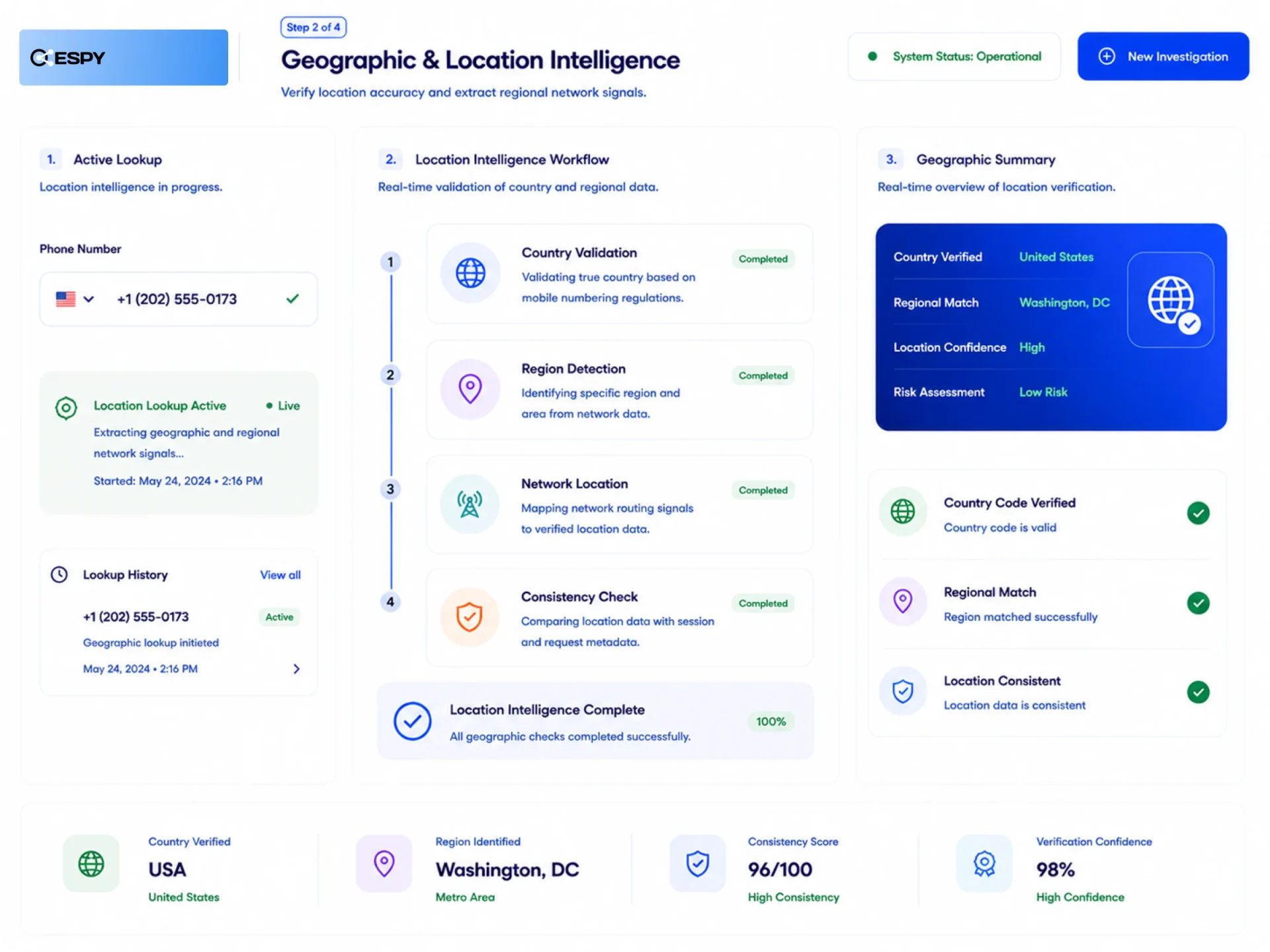
Compare Phone Routing Regions Against IP Geolocation Signals

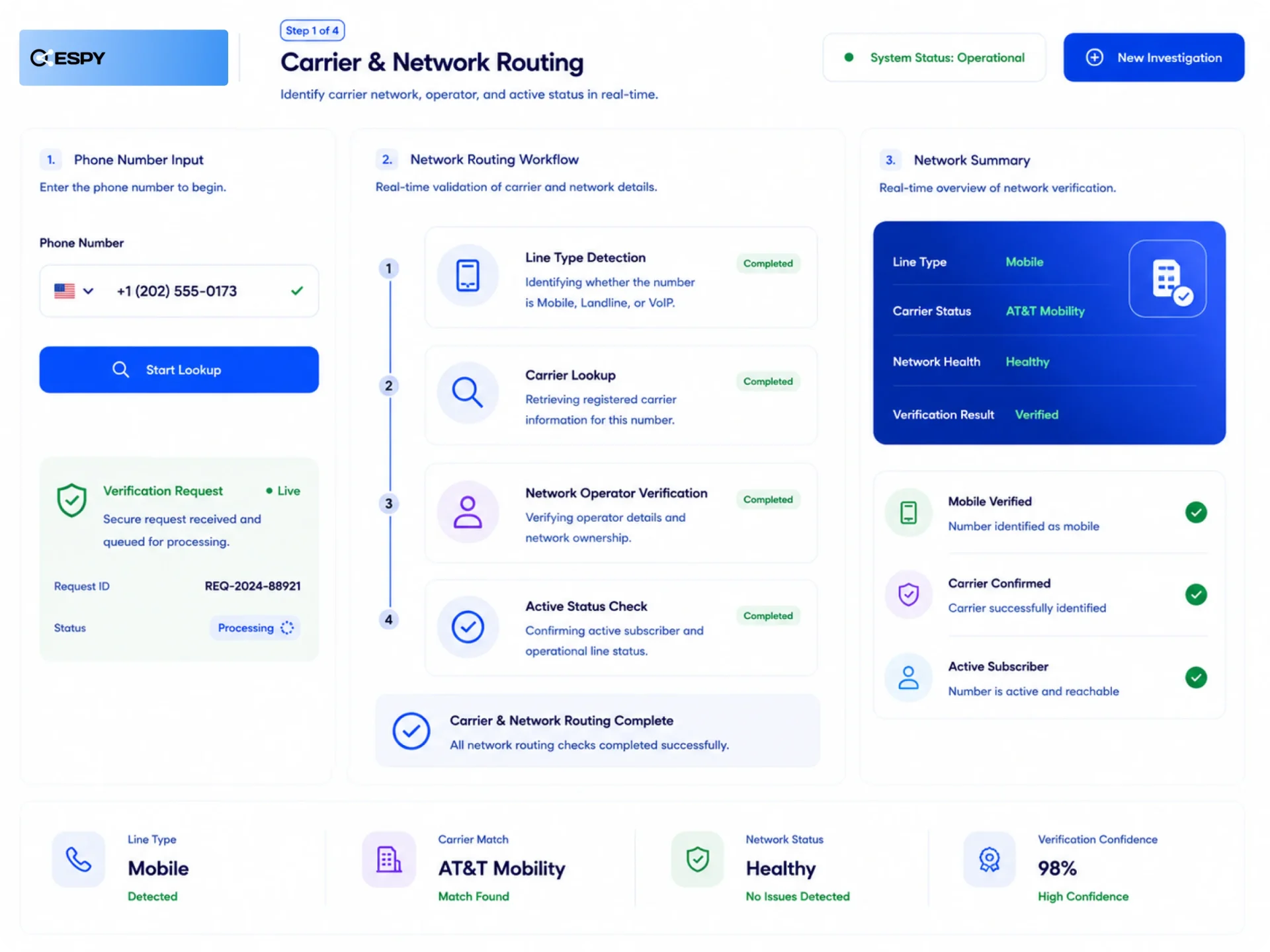
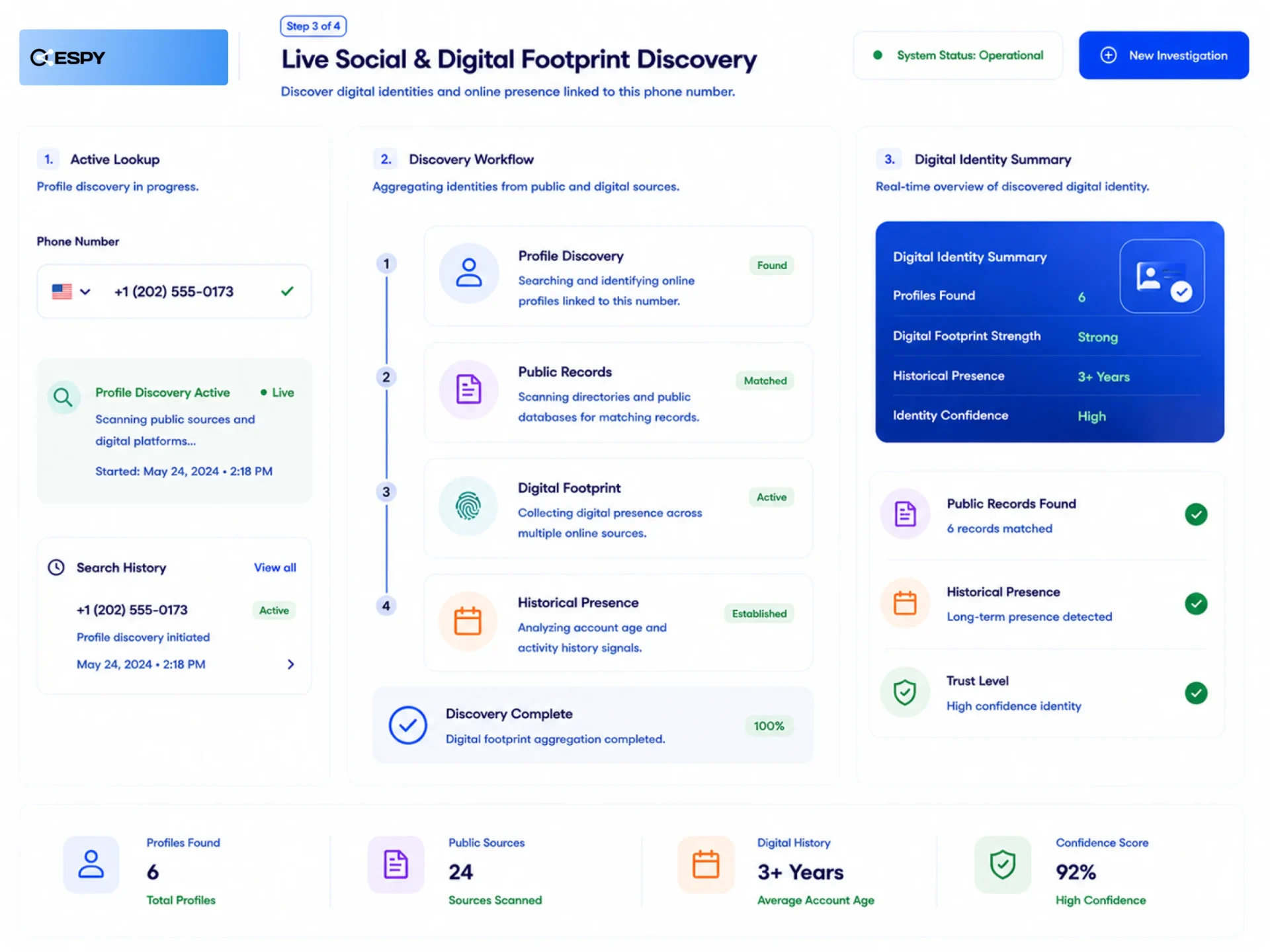
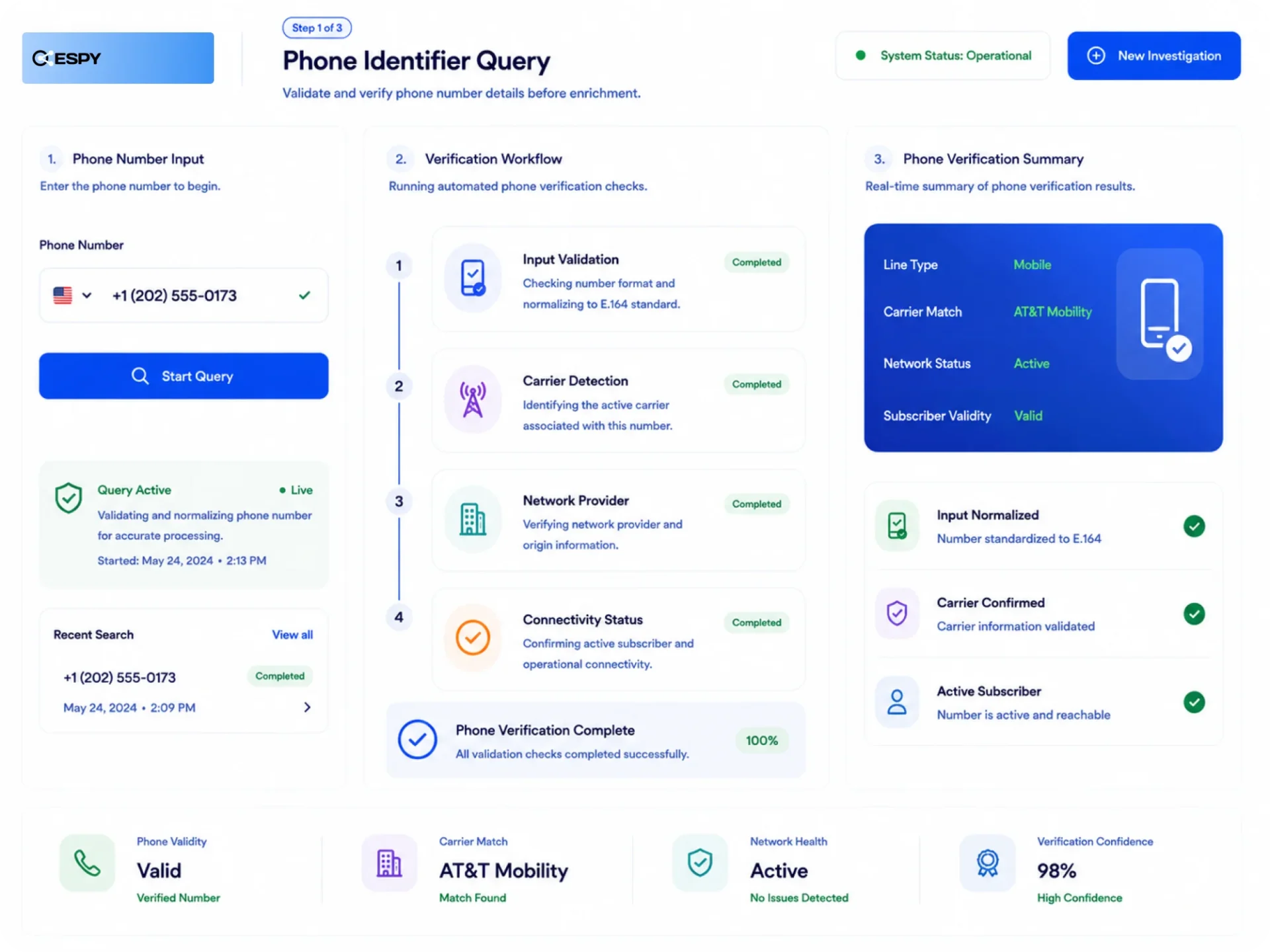
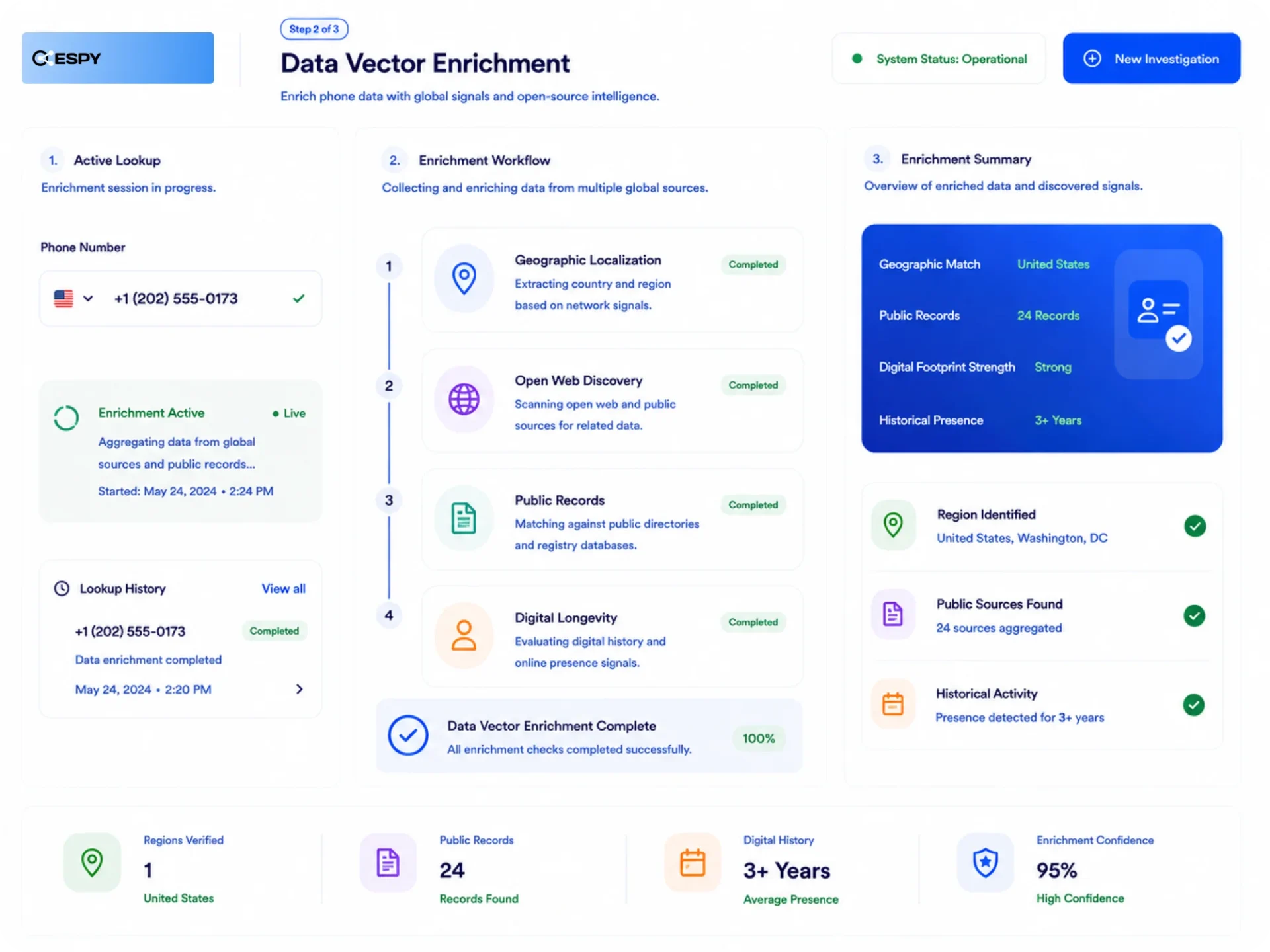
Checking phone numbers and IP addresses in separate tools leaves gaps in fraud workflows. ESPY parses both parameters in a single request, matching carrier regional signals with live IP coordinates to surface geographic discrepancies instantly.

Phone Country & Region Mapping

Query global telecom registries to identify the issuing country and regional origin tied to the submitted phone number.

IP Geolocation Lookup

Access live IP infrastructure metadata to pinpoint the country, region, and network origin of the incoming user connection.

Location Discrepancy Signal

Cross-reference location signals across both inputs to return structured pass, mismatch, or proxy indicators directly to your backend.

Automated Location Checks Built for Custom Fraud Workflows

 Integrate geographic validation logic directly into signup gates, checkout flows, and authentication backends via a lightweight RESTful endpoint.

RESTful Location Matching Engine

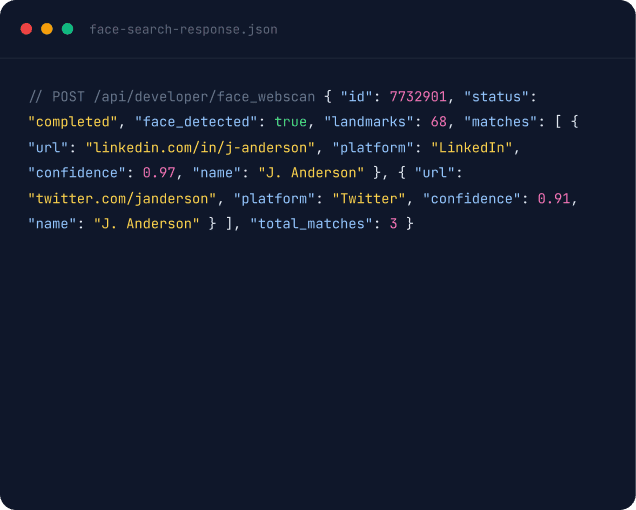
Send a phone number and IP address in a single API call to receive instant geographic comparison data. Optimized for high-throughput backends, the API delivers fast response times without slowing down onboarding or login UX.

  • Fast Response Times: Built for inline execution during signup, login, and payment flows.
  • Passive Network Telemetry: Check geographic consistency passively without asking users for invasive GPS permissions.
  • Automated Routing: Approve matched locations instantly while routing mismatches to step-up verification.

Proxy & Network Anonymizer Flags

Flag connections originating from commercial VPNs, TOR exit nodes, residential proxies, or data center hosting IP ranges. Combining proxy detection with phone country data helps spot attempts to bypass geo-restrictions.

  • Proxy & VPN Detection: Surface anonymized networks used to hide authentic physical user origins.
  • Virtual Line & Line Type Classification: Identify virtual VoIP numbers and burner lines paired with proxy connections.
  • Normalized Risk Indicators: Structured status flags allow your system to enforce custom risk thresholds.

Dynamic Workflow Integration & Webhooks

Use structured JSON responses to power internal risk engines and decision pipelines. Set up synchronous Webhooks to stream location mismatch alerts directly into your CRM, auth system, or fraud review queues.
  • Structured JSON Payloads: Machine-readable output ready for direct ingestion into backend logic.
  • Event-Driven Webhooks: Receive automated alerts when monitored accounts show sudden location changes.
  • Complete Audit Logging: Every API payload includes execution timestamps and source indicators for audit tracking.

Flexible Location Validation for Account Lifecycle Events

Stream geographic alignment signals into core application gateways, payment checkouts, and security reviews.

Need to start with partial data? The ESPY Phone vs IP Validation API can accept a Phone Number or IP Address independently via a single REST endpoint.

Every field returned by the Phone vs IP Validation API

Clean, normalized JSON responses structured for rapid backend parsing and automated decision routing.

What Can Phone vs IP Location Checks Reveal Beyond a Match

Combining telecom country data with IP infrastructure signals provides actionable context to refine customer-defined verification rules.

Country & Region Discrepancy

Flag differences between the issuing country of the phone number and the geographic origin of the IP address.

Proxy & VPN Anonymizer Detection

Uncover residential proxies, data center IP ranges, TOR exit nodes, and commercial VPNs used during registration or login.

Telecom Line Type Classification

Confirm whether submitted phone numbers belong to mobile networks, landlines, or virtual VoIP services.

ISP & Network Provider Attribution

Match internet service provider (ISP) and network infrastructure details across both input parameters.

Dynamic Risk Signal Weighting

Receive structured status codes that allow backend logic to apply custom pass, challenge, or manual review actions.

Synchronous Webhook Alerting

Receive automated Webhook notifications to update account risk statuses or trigger secondary MFA workflows in real time.

Developer Infrastructure for Automated Location & Identity Validation

ESPY’s Data Infrastructure helps engineering and risk teams cross-reference raw phone inputs with active IP network signals. Built as a high-performance RESTful pipeline, the system delivers structured metadata to power custom onboarding and fraud mitigation workflows.

Fast Response Times

Query Latency

Global Geographic

Coverage

Developer-Ready

REST API

ESPY checks input variables against active telecom registries and global IP datasets to surface location discrepancies. Engineered for software architects and fraud operations leaders, the architecture combines elastic infrastructure with structured JSON outputs to stream reliable risk data into your platform.

Parse, Compare, and Resolve Geographic Risk Signals

ESPY provides the technical data layer engineered to cross-reference phone routing regions against active IP geolocations inside a unified RESTful interface. Our platform combines passive network telemetry, anonymizer detection, and dynamic risk signals to power automated trust decisioning and fraud workflows.

Geographic Location Parsing

  1. Parse country and regional identifiers from submitted phone numbers and IP addresses simultaneously.
  2. Flag discrepancies between phone regional origins and active connection locations.
  3. Maintain lookup accuracy across international dialing codes and global IP ranges.

Proxy & Network Anonymizer Detection

  1. Cross-reference incoming IP addresses against active proxy, VPN, and TOR threat registries.
  2. Detect virtual VoIP numbers and temporary phone lines paired with masked IP connections.
  3. Enrich risk decisioning by attaching network classification flags to primary lookup records.

Workflow & Webhook Automation

  1. Trigger automated Webhook alerts when monitored entities show location discrepancies.
  2. Support custom risk policies including instant approval, step-up MFA, or manual queue routing.
  3. Streamline fraud audits with structured, machine-readable JSON payloads.

Why Technical Leaders Choose ESPY API

Traditional fraud tools check phone numbers and IP addresses in separate, isolated lookups. ESPY provides a low-latency API built for real-time geographic correlation.

Legacy: Fragmented Verification Lookups

ESPY: Phone vs IP Validation API

Real-Time Breach Monitoring for Modern Applications

Developer-First Breach Data Routing.

ESPY converts exposed account activity and breach data into structured JSON feeds designed for authentication systems, onboarding workflows, and fraud prevention platforms.

Built for high-volume, low-latency environments, ESPY provides developers with real-time breach monitoring infrastructure for modern product workflows.

Trusted by developers, system architects, and trust and safety teams worldwide.

Ronald Richards

CEO & Founder

How ESPY Location Validation Workflows Work

Connect phone and IP location checks to your application backend in minutes to automate customer verification workflows.

Capture Parameters & Submit REST Request

  1. Data Capture: Your application captures user inputs (Phone Number and IP Address) during registration or checkout.
  2. Payload Transmission: Your backend submits a structured JSON payload to the ESPY API endpoint.
  3. Parameter Parsing: The system extracts country and network indicators from both inputs simultaneously.

Compare Locations & Screen Anonymizers

  1. Location Matching: ESPY compares the phone’s issuing country against the IP address geolocation.
  2. Network Screening: The engine checks the IP connection for VPNs, proxies, and data center origins.
  3. Payload Compilation: The API combines location indicators, proxy status, and line types into a structured response.

Stream JSON Payload & Execute Platform Logic

  1. Payload Delivery: Results return as schema-valid JSON with fast response times.
  2. Webhook Integration: Stream verification payloads directly into your internal auth or fraud engine.
  3. Automated Decisioning: Your platform automatically approves clear profiles, requests MFA for mismatches, or flags high-risk signups.

ESPY Breach Feed API vs. Traditional Breach Databases

Traditional breach lists rely on static downloads and manual formatting. ESPY provides structured breach feeds designed for real-time authentication and onboarding workflows.

Feature Static Breach Databases Manual Forum Intelligence Standard SIEM Logs
Real-Time Ingestion Loop

Continuous Ingestion

Monthly Downloads

Opaque Manual

Internal Only

Source Attribution/Context

Continuous Ingestion

Not Supported

Difficult to Map

Lacks Context

Marketplace Monitoring

Active Dark Web

Not Supported

Unstructured

Not Supported

Automated Auth-Gate Block

Low-Latency API

Integration Fail

Manual Only

Manual Process

Actionable Risk Scores

Numeric Weights

Not Supported

Subjective

Not Supported

High-Volume Bulk Screening

Cloud-Elastic Sync

Database Slow

Scalability Fail

Performance Hit

Forensic Audit Integrity

Tamper-Evident Logs

Not Supported

Not Standard

Standard Log

Automated SOAR/SIEM Integration

JSON Ready

Manual Clean

No Supported

Native Support

Global Linguistic Crawling

Multilingual Scans

English Only

Human Limited

Not Supported

Privacy-First Handling
Secure Metadata

High Storage Risk

Security Risk

Compliant

Trusted by Industry Service Providers

How technical leaders integrate the ESPY Phone Intelligence API to power their registration workflows, fraud prevention, and user verification systems.

By integrating the ESPY API, platform teams can now run real-time app metadata checks across global databases, significantly reducing fake account creation and automated bot sign-ups during onboarding.

David Kim

Head of Trust & Safety

Access live profile metadata and regional code registries from over 195 countries to uncover risk indicators that traditional static reverse search directories cannot catch.

Marcus V.

Compliance Director

Risk operations use ESPY’s data layer to instantly detect unverified virtual VoIP lines and suspicious account setups. This adds a critical layer of active fraud detection to our existing user vetting suites.

James P.

Fraud Operations Manager

Built for developers. Our single-endpoint integration allows product teams to scale their user verification capabilities without adding complex system layout overhead or latency.

Ethan C.

Director of Product Security

Verify the active profile status and history of digital footprints linked to a number. Our programmatic query allows platforms to easily separate trusted, long-standing users from newly generated malicious threats.

Carlos R.

Lead Solutions Architect

Anti-fraud service providers leverage our phone intelligence to cross-reference mobile identifiers against open web registries, providing engineering teams with a more complete risk score.

Liam S.

Risk & Integrity Lead

Specialized security firms integrate our data pipeline to automate spam detection and reputation scoring, ensuring their platforms maintain clean user directories and meet regulatory compliance.

Liam A.

Senior Data Engineer

Frequently Asked Questions

Everything you need to know about network correlation, privacy compliance, proxy detection, and technical integration.

What does the Phone vs. IP Validation API check?

It compares the country associated with a phone number with the country identified from a submitted IP address and returns geographic information together with a match status.

No. A mismatch is an additional risk signal. Travel, roaming, corporate networks and other legitimate circumstances may produce different phone and IP countries.

No. The request uses the phone number and IP address provided to the API. It does not require access to the device’s GPS location.

Yes. The result can be incorporated into onboarding logic. For example, a matched result may proceed normally, while a mismatch may trigger another verification step.

The published Phone vs. IP Validator schema documents country comparison and match status. VPN or proxy detection should not be advertised for this endpoint unless ESPY confirms that these fields are included in the production response.

Results are returned as structured JSON that can be incorporated into existing applications and risk workflows.

The same documented service also supports an email_domain_validator lookup type. However, I recommend explaining this briefly or creating a separate Email Domain Validation page. Combining both topics too heavily would weaken the main Phone vs. IP SEO focus.

Add Phone and IP Consistency Checks to Your Workflow

Use ESPY’s Phone vs. IP Validation API to add a clear geographic consistency signal to customer onboarding, KYC, fraud prevention and account-security processes.

Related Guides

The Missing Piece in Modern Background Checks

Imagine you are about to hire someone, rent out a property, choose a contractor, or enter

How to Do Reverse Phone Lookup: A Practical Guide to Checking an Unknown Number

An unfamiliar number can be a nuisance or the first clue in a fraud review, customer

How to Maximize OSINT With Cognyte Analytics: A Practical Investigation Workflow

Poorly prepared information can weaken an investigation before analysis begins. Investigators studying how to maximize OSINT

Ready to Automate Geographic Location Checks?