
Table of Contents
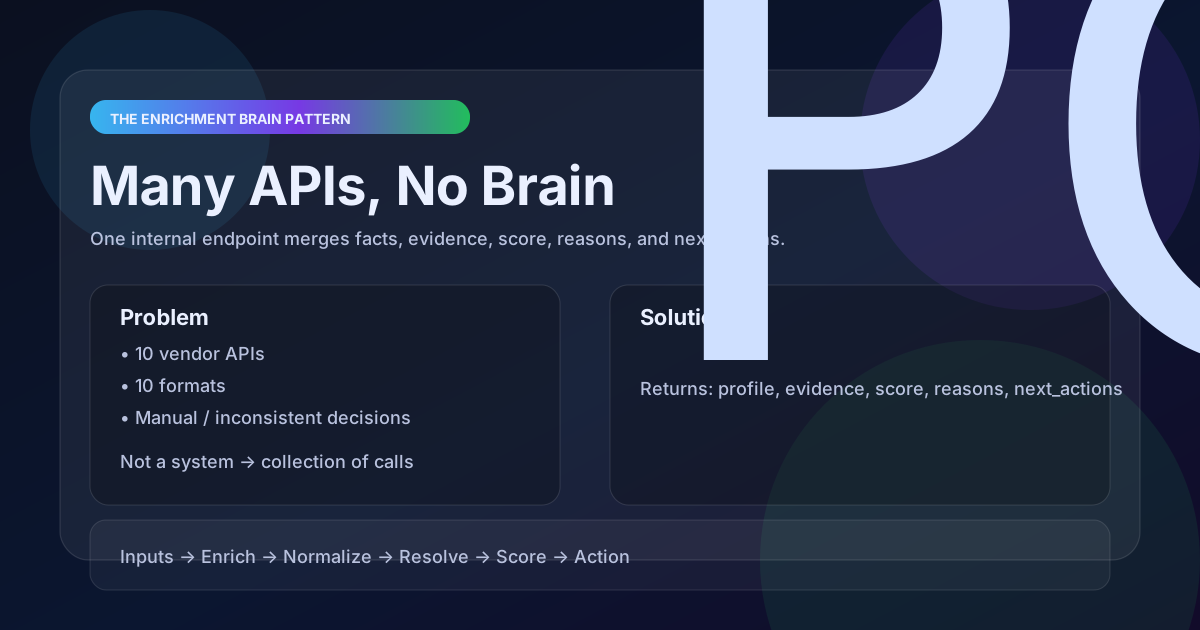
The Problem: Many APIs, No Brain
Most teams integrate APIs like this:
Phone lookup API
Email reputation API
Watchlist API
Court records API
Each API returns its own format.
Each team reads raw results.
Decisions are manual or inconsistent.
This is not a system.
It is a collection of calls.
You need one internal brain.
The Enrichment Brain Pattern
Your product should not call 10 vendors directly.
It should call one internal endpoint:
POST /enrich
And receive:
profile→ merged facts + conflictsevidence→ source + timestamp + confidencescore→ numeric risk/quality scorereasons→ human-readable explanationnext_actions→ what to do next
This is the core architecture of a multi-source data enrichment API.
Architecture Pattern
Simple pipeline:
Inputs
  ↓
Enrich (call multiple APIs)
  ↓
Normalize (standard format)
  ↓
Identity Resolve (link or separate entities)
  ↓
Score
  ↓
Action
Each block is independent.
This allows control and debugging.
Real Use-Case Scenario
A fintech app handles onboarding.
User submits:
Phone number
Email
Full name
The Enrichment Brain calls:
Phone intelligence API
Email validation + reputation API
Watchlist API
Court record search
Results:
Phone → linked to “Daniel Petrov”, confidence 0.82
Email → linked to “Dan Petrov”, confidence 0.76
Watchlist → no hit
Court → one possible match: “Daniel Petrov”, same city, low confidence
Now what?
If each result is separate, the product team is confused.
But the Enrichment Brain produces this:
Example Unified Profile
{
  "profile": {
    "input": {
      "name": "Daniel Petrov",
      "phone": "+359888123456",
      "email": "dan.petrov@gmail.com"
    },
    "resolved_entities": [
      {
        "entity_id": "person_1",
        "names": ["Daniel Petrov", "Dan Petrov"],
        "phones": ["+359888123456"],
        "emails": ["dan.petrov@gmail.com"],
        "possible_court_match": true
      }
    ],
    "conflicts": []
  },
  "score": 62,
  "reasons": [
    "Phone and email name variation match",
    "Possible low-confidence court record match"
  ],
  "next_actions": [
    "manual_review"
  ]
}
Now product logic is simple:
Score < 40 → auto approve
40–70 → manual review
70 → reject
This case goes to manual review.
Clear. Explainable. Controlled.
Decision Logic Layer
Important rule:
The Enrichment Brain does NOT approve or reject.
It outputs structured decision inputs.
Your product defines thresholds.
Example:
High cross-source agreement → lower risk
Conflicts between sources → increase risk
Watchlist hit → strong penalty
All scoring must be transparent.
Never hide logic inside one vendor.
What Can Go Wrong
1. False Merge
Same name + same city ≠ same person.
Never merge entities only because:
Common name
Same city
Same age range
Always require at least one strong identifier:
Exact phone match
Exact email match
Government ID (if applicable)
2. Overwriting Conflicts
If one API says:
Address: Sofia
And another says:
Address: Plovdiv
Do not overwrite.
Store both with evidence.
Conflicts are signals.
3. Stale Signals
Court record from 2012 is different from 2025.
Always store timestamp.
Score should decay old data.
Minimal Unified Profile Checklist
Your /enrich response must include:
Profile
Inputs
Resolved entities
Conflicts list
Evidence (per fact)
Source name
Timestamp
Confidence score
Reason or match rule
Scoring
Final numeric score
Clear reason codes
Next Actions
auto_approve
manual_review
reject
request_more_data
If any of these are missing, your system is incomplete.
How to Start Building
If you are testing enrichment APIs, start with:
Quick start:
https://espysys.com/irbis-api-quickstart-15-min/
Full API tutorial:
https://espysys.com/api-tutorial/
But remember:
Vendors are only data providers.
You must build the Brain.
Next Step
This week:
Design your
/enrichJSON contract.Define minimal evidence structure.
Define scoring thresholds.
Write simple merge rules (strong vs weak identifiers).
Do not add more vendors yet.
First build structure.
What Comes Next
Next week we go deeper:
How to store evidence correctly and manage conflicts without corrupting your profile.
That is where most systems fail.