
When engineering teams at the enterprise level ask what is KYC onboarding process optimization, they aren’t looking for regulatory definitions. They are facing a classic distributed systems problem: how to ingest heavy payloads (unstructured document images and biometric data), run multi-source third-party API lookups, and calculate risk scores in under a second—all while handling thousands of concurrent requests.
Treating identity verification as a synchronous, linear workflow is a recipe for system degradation. At scale, this architecture must be treated as a decoupled, event-driven pipeline designed for maximum throughput and fault tolerance.
Core Challenges in the Enterprise Identity Lifecycle
To build a high-performance system, we must break down what is KYC onboarding process architecture from a pure backend perspective. The process relies on external APIs, heavy data transformations, and cryptographic logging-each representing a distinct point of failure.
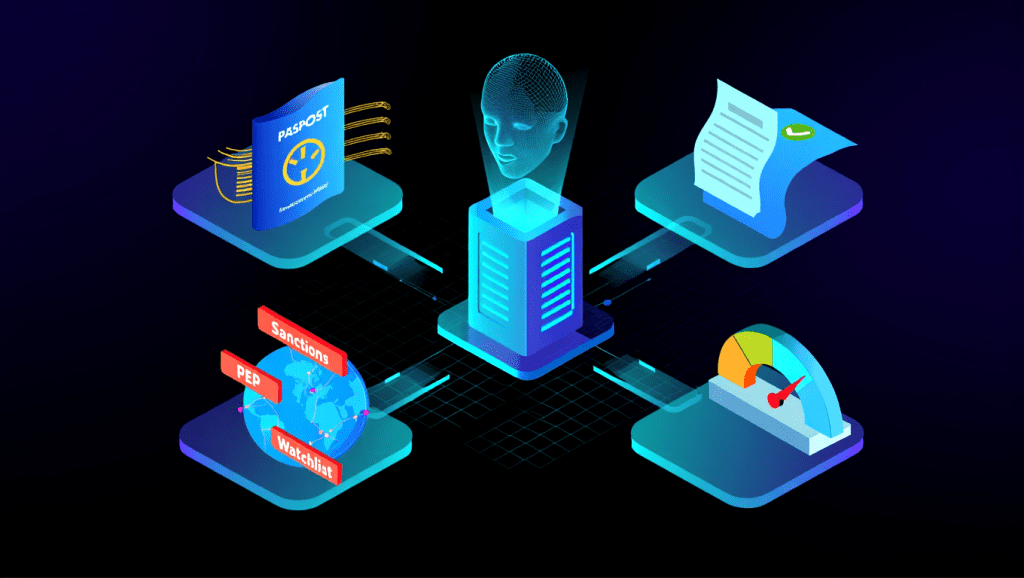
The Data Ingestion Challenges
Most systems fail during the initial intake because they handle image parsing and metadata extraction on the primary application thread. High-fidelity biometrics and high-resolution ID scans create severe memory overhead.

A resilient architecture deploys an asynchronous, non-blocking ingestion layer. When a user uploads identity telemetry, the application should instantly return a 202 Accepted status, offloading the heavy payload to background workers via message queues (such as RabbitMQ or Apache Kafka).
Third-Party API Dependency and Latency
Every identity pipeline depends on external lookups-government databases, sanctions watchlists, and PEP (Politically Exposed Persons) registries. These external networks introduce unpredictable latency and frequent downtime.
If your core onboarding logic blocks while waiting for a response from a slow national registry, your entire connection pool can exhaust rapidly, cascading into an application-wide outage.
Architectural Blueprint for Scalable Verification
Optimizing what is KYC onboarding process workflows requires decoupling components to isolate latency.
| Pipeline Stage | Technical Implementation | Systemic Impact |
|---|---|---|
| Ingestion Layer | Asynchronous Message Queues | Keeps frontend non-blocking; eliminates timeout errors |
| Validation Engine | Edge Caching & Localized Scoring | Eliminates redundant external API round-trips |
| Failover Routing | Multi-Source Dynamic Fallbacks | Maintains 99.99% uptime during vendor outages |
| Audit Storage | Append-Only Immutable Ledgers | Ensures zero-overhead compliance logging |
Implementing Multi-Source Failover Logic
To mitigate vendor downtime, the identity pipeline must manage multi-source failover automatically. ESPY’s infrastructure uses deterministic routing logic: if the primary validation vector experiences a timeout or a 5xx error, the payload is instantly rerouted to a secondary validation source. This happens entirely in the background, ensuring zero disruption to the system’s runtime.
Designing an Automated Risk Scoring Framework
Raw telemetry is useless without an objective decisioning engine. Traditional systems rely on manual reviews or hardcoded, static rules that fail to scale. Modern platforms require a dynamic scoring framework that processes risk variables in real time.
Edge Intelligence and Watchlist Screening
Running global sanctions and PEP screening on every single login or transaction creates massive infrastructure overhead. To protect performance, intelligence signals should be cached at the edge. By maintaining a localized, high-speed cache of verified profiles and global watchlists, you eliminate the need for redundant external API calls, reducing lookup latency to sub-millisecond levels.
Dynamic Categorization
Static risk thresholds create high false-positive rates. The scoring engine must dynamically evaluate data depth. If a profile contains high-fidelity biometric data matched against a verified national registry, the system routes it through Standard Due Diligence (SDD). If the data signals are shallow or ambiguous, the engine flags the entity for Enhanced Due Diligence (EDD) without stalling the entire pipeline.
Audit-by-Design: Immutable Compliance Logging
Regulators require a tamper-proof, sequential record of every identity decision made across the customer lifecycle. Building an infrastructure that satisfies what is KYC onboarding process standards means architecting an unalterable audit layer.
Instead of writing standard application logs to a volatile database, developers should implement append-only, cryptographically signed event streams. Every stage of the verification-from the initial OCR extraction to the final risk score calculation-must be captured in this immutable log. This removes the performance tax of generating manual compliance reports and ensures instant defensibility during regulatory audits.
API-First Ecosystem Integration
An isolated identity layer creates operational friction. The onboarding pipeline must feature an API-first design that pushes webhook notifications directly into transaction monitoring and fraud detection engines. This unified data orchestration prevents silos and ensures that post-onboarding behavior is continuously screened against the initial risk profile.
Developer Resources
Architects can leverage these resources to accelerate deployment:
- Quickstart: Basic pipeline configuration and message queue setup.
- Tutorial: Step-by-step integration walkthrough with core financial rails.
- API Documentation: Comprehensive technical specifications and endpoint schemas.
Conclusion
Evaluating what is KYC onboarding process engineering reveals that scalability is a matter of decoupling, caching, and automation. By shifting to an asynchronous, event-driven architecture with built-in multi-source failover, engineering teams can eliminate processing lag and maintain strict compliance. Leveraging professional data infrastructure ensures that the verification pipeline operates as a scalable engine, transforming regulatory requirements into a system performance advantage.
Whether your team is currently struggling with pipeline latency during heavy document processing or facing challenges building a reliable scoring engine for custom risk logic, ESPY provides the production-ready infrastructure to solve it.
Connect with the ESPY engineering team today to benchmark your throughput and optimize your identity pipeline.